IBM 4003-701X Memory Module Simm 51G8554 74G1235 8MB
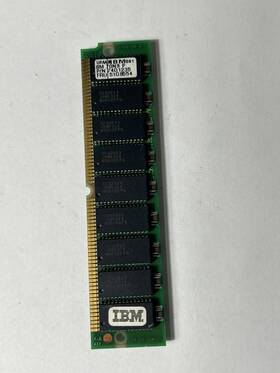
( Brand: Ibm ), ( Manufacturer Part Number: 4003-701X ), ( Form Factor: Simm ), ( Type: Edo Ram ), ( Total Capacity: 8 Mb ), ( Number Of Pins: 72 ), ( Bus Speed: 70 Ns )
Review IBM 8mb 1x Memory Module Simm Good Condition
The **IBM 4003-701X 51G8554 74G1235 8MB 1x SIMM memory module** is a rare and highly sought-after component from IBM s mid-range AS/400 (System i) series, designed to enhance the performance and capacity of select models within the IBM 4000 architecture. This **Single Inline Memory Module (SIMM)** is a critical upgrade for systems requiring additional random access memory (RAM) to support expanded workloads, including enterprise applications, database management, or legacy business software. Manufactured with precision engineering, this module features **8 megabytes (MB) of dynamic random-access memory (DRAM)**, delivered in a single 30-pin SIMM configuration, which was a standard interface for mid-1990s IBM AS/400 systems. The **51G8554** and **74G1235** part numbers indicate its compatibility with specific IBM 4000 models, such as the **IBM AS/400 Model 701X**, ensuring seamless integration without compatibility issues. Built with **fast-access DRAM chips**, this module was engineered to operate efficiently within the system s clock speeds, providing reliable memory expansion for tasks ranging from transaction processing to complex data analytics. Due to its age, this component is now a collector s item and a valuable asset for system restorations or archival computing projects, where maintaining original hardware specifications is essential. Whether used in a museum-grade AS/400 setup, a retro computing enthusiast s collection, or a business environment preserving legacy systems, this memory module exemplifies IBM s legacy of robust, high-performance computing solutions. Its inclusion in an AS/400 configuration would have significantly improved system responsiveness, allowing for smoother multitasking and larger data handling capabilities during its operational era.
### **Pros and Cons of Buying an IBM 4003-701X 51G8554/74G1235 8MB SIMM Memory Module**
#### **Pros:**1. **Compatibility with Legacy Systems** This is a **SIMM (Single Inline Memory Module)** designed for older IBM midrange servers, specifically the **IBM AS/400 (iSeries) or System i** models from the late 1990s to early 2000s. If you have a compatible system, this module will function as intended.
2. **Reliability in Stable Environments** SIMMs were used in older hardware where stability was prioritized over speed. If your system is in a controlled environment and not subjected to frequent power fluctuations, this module may provide long-term reliability.
3. **Potential for Cost Savings** If you are maintaining an older IBM system that no longer has official support, this module could be a **cheaper alternative** to purchasing new memory or upgrading to a modern system.
4. **Historical Value for Collectors** Some enthusiasts or collectors of vintage computing hardware may find this module of interest for preservation or display purposes.
5. **No Modern Compatibility Issues** Unlike newer memory types (DIMM, RDIMM, etc.), this SIMM will not cause compatibility problems in its intended system, assuming the slot and voltage requirements match.
---
#### **Cons:**1. **Extremely Limited Availability** Finding a **new or even used** 8MB SIMM for this specific part number (51G8554/74G1235) is **exceptionally difficult**. Most suppliers no longer stock legacy IBM memory, and eBay or auction sites may have few, if any, listings.
2. **High Risk of Counterfeit or Fake Parts** Due to scarcity, there is a significant chance of encountering **counterfeit or refurbished modules** that may not function correctly. Without proper testing, you risk wasting money on a faulty part.
3. **No Long-Term Support or Warranty** IBM no longer provides **technical support, firmware updates, or warranties** for this hardware. If the module fails, you are on your own for replacements or diagnostics.
4. **Performance Limitations** An **8MB SIMM** is **extremely small** by modern standards. Even for older systems, this is likely insufficient for modern workloads. Most AS/400 systems required **much larger memory configurations** (often 1GB for basic operation).
5. **Physical and Electrical Compatibility Risks** If the system s memory slots are damaged, corroded, or not properly seated, inserting an old SIMM could cause **further hardware damage**. Testing in a known-working system is essential.
6. **No Future-Proofing** If you are considering this purchase to **extend the life of an old system**, the reality is that **IBM AS/400 hardware from this era is obsolete**. Modern operating systems (like IBM i 7.5 ) may not run efficiently, if at all, on such limited hardware.
7. **Potential for System Instability** Adding old memory to a system that has been running for decades may introduce **instability due to aging components**. The system s BIOS, power supply, or other hardware may fail when combined with new (or old) memory.
8. **No Official Documentation or Testing** Unlike modern memory, there is **no guaranteed compatibility testing** for this module. You would need to manually verify its function in your specific system.
---
### **Conclusion:** Buying this **IBM 4003-701X 51G8554/74G1235 8MB SIMM** is **highly speculative** and only makes sense in **very specific scenarios**:- **You have a rare, fully functional IBM AS/400 system** that **absolutely requires** this exact memory module (e.g., a critical legacy application that no longer runs on newer hardware).
- **You are a collector** and are willing to accept the risks for historical preservation.
- **You have already exhausted all other options** (e.g., no new memory is available, and the system is irreplaceable).
In **all other cases**, this purchase is **not recommended** due to:- The **extremely low likelihood of finding a genuine, working module**.
- The **lack of support, warranty, or future compatibility**.
- The **impracticality of using such limited memory** in modern or even mid-2000s workloads.
---
### **Recommendation:**1. **Verify System Compatibility First** Confirm that your IBM AS/400 model **actually uses this exact SIMM type** (some models had different part numbers). Check IBM s historical documentation or contact a **legacy IBM hardware specialist** for confirmation.
2. **Search Extensively for Alternatives** Before purchasing:- Check **eBay, Facebook Marketplace, or specialized vintage computing forums** (e.g., IBM i Community, AS/400 forums).
- Consider **larger-capacity SIMMs** (e.g., 32MB, 64MB) if available, as they would be more useful.
- Explore **modern alternatives** like **IBM i on Power Systems (PowerVM, Power9)** if the goal is to **migrate away from obsolete hardware**.
3. **Test in a Safe Environment** If you acquire the module, **test it in a known-working system** before installing it in your primary machine.
4. **Consider Professional Restoration** If the system is **critical**, consult an **IBM AS/400 specialist** who may have access to **genuine, tested memory** or can help assess whether upgrading to a **modern IBM i appliance** is feasible.
5. **Avoid Counterfeit Parts** If purchasing from an unknown seller, **demand a return policy** and **verify the module s authenticity** (e.g., check for proper labeling, IBM part numbers, and physical condition).
6. **Evaluate Long-Term Viability** If the system is **not mission-critical**, **migrate to a supported IBM i environment** (e.g., Power Systems with IBM i 7.5 ) rather than relying on **decades-old hardware**.
### **Final Verdict:****Do not buy this SIMM unless absolutely necessary.** The risks (scarcity, counterfeits, lack of support) far outweigh the benefits in nearly all cases. If you must proceed, **prioritize finding a tested, genuine module** and **plan for a long-term migration strategy** away from this obsolete hardware.
Details:
Ships fast and free in anti-static.
part #: 4003701x prices
- $10.00-$25.00
specifications servermemor:
- brand: Ibm
- mpn: 4003-701x
- form factor: Simm
- type: Edo Ram
- total capacity: 8 Mb
- number of pins: 72
- bus speed: 70 Ns
general servermemor:
- condition: Used
- Enterprise Networking, Servers > Server Components > Server Memory RAM
seller servermemor:
- city: Ann Arbor, Michigan
- rating: 99.2%
- # reviews: 6448
shipping servermemor:
- service: USPS Ground Advantage, USPS Priority Mail, USPS Priority Mail Express
- type: Fixed
- class: Standard, Expedited
- transit: 4-8 Days
- cost: $0.00
- carrier: USPS
returns servermemor:
- time: 30 Days
- method: Money back
- paid by: Seller
- policy: Returns Accepted
payments servermemor:
- wallet: Google-pay
- other
- credit card: Diners-club
offer servermemor:
- best offers: True
- options: Ship-to-home
- availability: In Stock
- sold: 0
- quantity: 4
- started: February 19, 2026
Ibm 4003-701X Is Similar To:
- 0.5543024527052227 Total Server Ram Memory Ibm (29.3% similar) I'll get back to you as soon I can. No other accessories hardware software...(March 21st, 2019)
- 0000435929952 Ibm Sdram Memory Module (35.5% similar) We scan the serial numbers of all outgoing items for verification if a return is accepted. For all new products, warranty is carried out by the respective manufacturer unless specified otherwise. Wrong parts ordered by the customer as such, requests to do so will not be fulfilled. Refer to the page...(April 20th, 2018)
- 0087944507505 Ibm Mb Dimm Memory Upgrade Pin Sdram Brand (34.9% similar) Fast and free shipping is included. Brand new and never opened...(June 27th, 2018)
- 00d4987 Ibm Vlp Server Memory Module (35.8% similar) High quality 100 original fast shipping...(June 21st, 2018)
- 00d5026 Ibm Reg Ecc Server Memory Module (38.2% similar) High quality 100 original fast shipping...(December 11th, 2018)
- 00e0635 Ibm Memory Riser Card (38.4% similar) Lock: L1LID: hat: RPC110217 warranty 30-DAY money back guarantee. Quantity: 1 Frau: 00E0635 accessories included:pictured item only...(November 2nd, 2017)
- 00e0638 Ibm Memory Riser 74y3592 (25.5% similar) It was pulled from a new or fully functioning environment and is guaranteed non DOA. Ibm 00E0638 with 90 day warranty...(April 9th, 2017)
- 00j0059 Ibm Ram Server Memory Hvar (26.9% similar) Please look at the pictures carefully. Working pull. Ibm 2X9GB 18GB ram DDR3 server memory WFD2 var 00J0059 00E5864 K4B2G0846D-HYH9...(September 15th, 2018)
- 00ja664 Ibm 32gb Ddr3 Memory 658759197917 (28.8% similar) Please investigate your local import requirements prior to purchase as there may be such fees at the time of or receipt. Substitute part numbers:with it parts, there are often identical sub numbers available for that which merely designate factory the item was made at or perhaps production batch. ...(January 10th, 2018)
- 00lp639 Ibm Cdimm Dram Memory (26.3% similar) Ibm 00LP639 64GB DDR4 comm dram 1600MHZ memory 8GX72. Freshly pulled...(August 20th, 2018)
- 00lp726 Ibm Samsung Memory Cdimm Dram For (36% similar) Product quality conditions: all of our a mainly used refurbished item so its natural for an to have cosmetic wear and tear on them. Bubble wrap static-bag shipping packing: package star Ibm 00LP726 32GB DDR3 1600MHZ memory M351B4G73DB0 comm dram for POWER8 part number Samsung brand power 8 ...(July 12th, 2018)