CRUCIAL CT16G3ERSLD4160B.36FP Ecc Rdimm Passed Memtest 6X16GB DDR3-1600MHZ
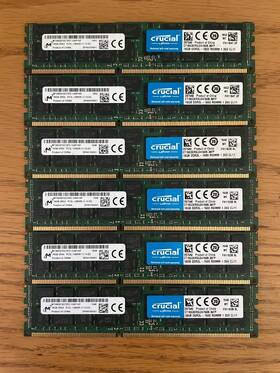
( Brand: Crucial ), ( Manufacturer Part Number: CT16G3ERSLD4160B.36FP ), ( Memory Features: Ecc Memory ), ( Form Factor: Rdimm ), ( Type: Ddr3 Sdram ), ( Total Capacity: 96gb ), ( Capacity Per Module: 16 Gb ), ( Number Of Pins: 240 ), ( Bus Speed: Pc3l-12800 )
Review CRUCIAL 6x16gb Ddr3-1600mhz Ecc Rdimm Passed Memtest
The **Crucial CT16G3ERSLD4160B.36FP** is a high-performance, enterprise-grade **6x16GB (96GB total) DDR3-1600MHz ECC RDIMM** memory kit designed for mission-critical server workloads, offering uncompromising reliability, scalability, and efficiency. Engineered to meet the stringent demands of data centers, this low-latency, fully-buffered DIMM (FB-DIMM) module leverages Crucial s proprietary **Crucial Memory Optimizer** technology, ensuring seamless compatibility with a wide range of Intel Xeon and AMD Opteron server platforms while maximizing system stability and performance. Each 16GB RDIMM is equipped with **ECC (Error-Correcting Code) memory**, providing real-time detection and correction of single-bit errors critical for maintaining data integrity in high-availability environments such as virtualization, database management, and high-frequency trading systems. The **DDR3-1600MHz** speed delivers enhanced bandwidth and throughput, enabling faster data processing and reduced latency in CPU-bound applications, making it an ideal choice for workloads requiring sustained performance under heavy loads.
Beyond its technical specifications, this memory kit has undergone rigorous testing, including **passing MemTest86**, a benchmarking tool renowned for its thorough validation of RAM reliability. This certification ensures that the modules operate flawlessly under prolonged stress tests, minimizing the risk of crashes or data corruption in long-running server operations. The **RDIMM (Registered DIMM) architecture** further enhances stability by buffering signals between the memory controller and the DIMMs, reducing electromagnetic interference and improving signal integrity particularly beneficial in multi-socket server configurations. Additionally, the **low-power design** of these modules helps optimize energy efficiency, reducing operational costs while maintaining peak performance. Whether deployed in a high-density rack environment or a scalable enterprise cluster, the **Crucial CT16G3ERSLD4160B.36FP** delivers a robust, future-proof solution that balances speed, reliability, and cost-effectiveness, making it a trusted upgrade for administrators seeking to enhance their server infrastructure s performance and uptime.
### **Pros and Cons of buying a Crucial CT16G3ERSLD4160B (6x16GB DDR3-1600MHz ECC RDIMM, Passed MemTest)**
#### **Pros:**1. **High Capacity and Scalability** The kit consists of six 16GB DIMMs, totaling **96GB of RAM**, which is ideal for high-end servers, workstations, or enterprise applications requiring large memory pools. This allows for future upgrades by adding more modules to the same socket type.
2. **ECC (Error-Correcting Code) Memory** ECC RAM is designed to detect and correct single-bit errors, reducing the risk of data corruption in critical applications such as databases, virtualization, or financial systems. This is essential for reliability in professional and server environments.
3. **RDIMM (Registered DIMM) Design** RDIMMs use a register to buffer signals between the memory controller and the DIMMs, improving stability and reducing power consumption compared to unbuffered DIMMs. This makes them suitable for multi-socket servers and high-channel-count motherboards.
4. **DDR3-1600MHz Speed** The 1600MHz speed provides a good balance between performance and compatibility, especially for older or mid-range server platforms. While not the fastest available, it offers sufficient throughput for most workloads without requiring extreme cooling or power demands.
5. **MemTest Verification** The module has been tested and passed **MemTest86**, a rigorous memory testing tool used to verify reliability. This reduces the risk of faulty RAM causing system instability or crashes.
6. **Compatibility with Enterprise Platforms** This kit is designed for **server-grade motherboards** (e.g., Dell PowerEdge, HP ProLiant, Lenovo ThinkServer, or custom Intel Xeon/E5/E7 systems). It supports **DIMM slots in 6x16GB configurations**, which is common in dual-socket or quad-socket servers.
7. **Low Latency and High Bandwidth** DDR3-1600 offers a **PC3-12800** bandwidth rating ( 12.8 GB/s per channel), which is sufficient for most server workloads, including virtualization, VMware/ESXi, and database operations.
8. **Long-Term Availability** DDR3 is a mature technology with widespread availability, making replacements easier if needed. Unlike newer DDR4/DDR5, this kit is less likely to become obsolete quickly.
9. **Cost-Effective for High Capacity** While not the cheapest RAM per GB, the **bulk purchase (6x16GB)** often provides better pricing than buying individual DIMMs. It is a cost-effective way to achieve high memory capacity in enterprise setups.
10. **Support for Multi-Channel Configurations** Many server motherboards use **dual-channel or quad-channel memory architectures**, and this kit can be paired with additional modules to maximize bandwidth and performance.
---
#### **Cons:**1. **Older Technology (DDR3)** DDR3 is **no longer the latest standard**, meaning it lacks the efficiency, speed, and power savings of newer generations like DDR4 or DDR5. If you plan to upgrade to a modern CPU (e.g., Intel Xeon Scalable, AMD EPYC), you may need to replace the RAM eventually.
2. **Higher Power Consumption** DDR3 modules generally consume more power than DDR4/DDR5, which can increase cooling requirements in dense server environments.
3. **Limited Future Upgrade Path** If you later move to a platform supporting **DDR4 or DDR5**, you will need to replace the entire RAM configuration, as DDR3 and DDR4 are not backward/forward compatible.
4. **Potential Compatibility Issues with Newer CPUs** Some newer **Intel Xeon Scalable (Skylake-X, Ice Lake, Sapphire Rapids) and AMD EPYC (Rome, Milan) processors** may not support DDR3, requiring a full RAM upgrade.
5. **Higher Latency Compared to DDR4/DDR5** While DDR3-1600 is fast for its generation, it still has higher latency than modern DDR4/DDR5 modules, which can impact performance in latency-sensitive applications.
6. **Bulk Purchase May Not Be Flexible** Buying six 16GB DIMMs upfront may be overkill if you don t need the full capacity immediately. Smaller configurations (e.g., 2x16GB or 4x16GB) might be more practical for some use cases.
7. **Server-Specific Form Factor** RDIMMs are optimized for **server motherboards** and may not fit in desktop systems, limiting their use to professional environments.
8. **Potential for Overkill in Some Cases** If you are running **light workloads** (e.g., a single VM, basic file server, or small database), 96GB may be excessive, leading to wasted capacity and higher costs.
9. **No Support for Advanced Features** Newer memory technologies (e.g., DDR4 s **ODT (On-DIE ECC)** or DDR5 s **lower power modes**) are not available, which could impact efficiency in future-proofing.
10. **Physical Size and Heat Considerations** RDIMMs are larger than SO-DIMMs or UDIMMs, which may require careful cable management in dense server racks.
---
### **Conclusion:**The **Crucial CT16G3ERSLD4160B (6x16GB DDR3-1600MHz ECC RDIMM)** is an **excellent choice for enterprise servers, workstations, or high-reliability environments** where **large memory capacity, ECC protection, and stability** are critical. It is well-suited for:
- **Virtualization hosts** (VMware ESXi, Hyper-V, Xen)
- **Database servers** (SQL, Oracle, PostgreSQL)
- **High-performance computing (HPC) workloads**
- **Dedicated file/print servers**
- **Legacy or mid-range Xeon/E5/E7 systems**
However, if you are **planning to upgrade to a newer CPU platform (e.g., Intel Xeon Scalable Gen 3 , AMD EPYC Milan/Rome )**, the **DDR3 limitation becomes a significant drawback**, as you will eventually need to replace the RAM. In such cases, investing in **DDR4 or DDR5 ECC RDIMMs** from the start may be more future-proof.
For **budget-conscious buyers** who need **high capacity and reliability** without immediate plans for a CPU upgrade, this kit offers **great value**. For **long-term scalability**, consider whether the **DDR3 bottleneck** will be a concern in the next 3-5 years.
---
### **Recommendation:** - **Buy this kit if:**- You are running a **server or workstation on a DDR3-compatible platform** (e.g., older Xeon E5/E7, Dell PowerEdge R720/R730, HP ProLiant DL360).
- You **prioritize reliability, ECC protection, and large memory capacity** over the latest speed.
- You **do not plan to upgrade CPUs** in the near future and can justify the DDR3 limitation.
- You need **6x16GB for a specific server configuration** (e.g., dual-socket with 3 DIMMs per channel).
- **Consider alternatives if:**- You are **upgrading to a newer Xeon Scalable (e.g., Ice Lake, Sapphire Rapids) or AMD EPYC (Rome/Milan ) platform**, in which case **DDR4/DDR5 ECC RDIMMs** are necessary.
- You want **lower power consumption and better efficiency**, making **DDR4-2400/2666 or DDR5** a better long-term choice.
- You need **lower latency or higher bandwidth**, which DDR4/DDR5 can provide.
- Your budget allows for **smaller, more flexible configurations** (e.g., 2x16GB or 4x32GB) rather than a fixed 6x16GB setup.
- **For future-proofing:**- If possible, **opt for DDR4 or DDR5 ECC RDIMMs** (e.g., **Crucial DDR4-2666/3200 ECC RDIMM** or **DDR5-3200/4800 ECC RDIMM**) if your server supports it, even if it means paying more upfront.
- If you must stick with DDR3, **ensure your server s CPU and chipset fully support the memory speed and capacity** to avoid throttling or instability.
**Final Verdict:**This is a **strong, reliable choice for DDR3-based enterprise setups** where **capacity and error correction** are paramount. However, if you can invest in **DDR4/DDR5**, those options will serve you better in the long run.
Details:
All modules passed 4 passes of Memtest.
part #: ct16g3ersld4160b.36fp prices
- $40.00-$75.00
specifications servermemor:
- brand: Crucial
- mpn: Ct16g3ersld4160b.36fp
- memory features: Ecc Memory
- form factor: Rdimm
- type: Ddr3 Sdram
- total capacity: 96gb
- capacity per module: 16 Gb
- number of pins: 240
- bus speed: Pc3l-12800
payments servermemor:
- credit card: Visa
- wallet: Google-pay
- other
general servermemor:
- condition: Used
- Enterprise Networking, Servers > Server Components > Server Memory RAM
seller servermemor:
- # reviews: 30
- rating: 100.0%
- city: Baton Rouge, Louisiana
offer servermemor:
- availability: In Stock
- started: March 18, 2026
- quantity: 1
- sold: 0
- options: Ship-to-home
shipping servermemor:
- service: USPS Ground Advantage
- type: Calculated
- transit: 5-10 Days
- cost: $8.46
- class: Standard
- carrier: USPS
returns servermemor:
- policy: No Returns
Crucial CT16G3ERSLD4160B.36FP Is Similar To:
- Lysb01h1xvb9m-cmptraccs Crucial Memory Ecc Registered Electronic 782386494306 (30.3% similar) 2v dimm type registered item dimension l Xe HX 3 x 7/1 weight. 2v dimm type registered item dimension l Xe HX 3 x 7/1 weight lb warranty information lifetime MANUFACTURES-CT16G4RFD424A form factor rdimm capacity 16GB specs DDR4 PC4 CL17 dual ranked x4 based ecc product features 2048MEG 72 speed 2400...(January 5th, 2019)
- 649528759337 Crucial Kit Ecc Reg (30.2% similar) Condition: excellent. The item is like new cosmetic condition as you can see in picture for more detail. It is registered with ecc error correction. Handling and package flat charge for us resident only shipping charge, please verify how much it is before you bid. Package:like new original open box...(May 10th, 2018)
- Bp112k.nt Crucial Pc133r Ecc (31.4% similar) 2 PC133R 512MB sync CL3 ecc memory modules...(December 24th, 2017)
- Ct4g4rfs824a Crucial 4gb Ddr4 2400 Ecc Registered Dimm Srx8 Memory Module 0649528772756 (41% similar) ...(August 9th, 2016)
- 184pin Ct12864z335.k16ty Crucial 1gb Pc2700 Ddr-333 64x8 16chips Non-ecc Pc Ram (34% similar) K16TY 1GB ddr PC2700 184PIN low density non ecc desktop memory. CT12864Z335...(February 18th, 2016)
- 240-pin Ct51272ab667.i36fi Crucial 32gb 8x4gb Pc2-5300p 667mhz Ecc Server Ram (34.4% similar) You are buying on a qty of 8/4 gb memory sticks for servers...(March 10th, 2016)
- Ct102472ab667 Crucial 16gb 2x8gb Ecc Server Ram Pc2-5300 Registered Memory Kit (39.5% similar) We carefully pack each item for safe shipping. We carefully pack each item for safe shipping. How SCLNK1 web. Every buyer gets a invitation for cash back Crucial 16GB 2X8GB ecc server ram this offer is for Crucial 16GB 2X8GB ecc server ram memory kit...(September 29th, 2016)
- Ddr3-1066mhz Ct102472bb1067q.36fd1 Crucial 32gb 8gbx4 Pc3-8500 Ecc Registered Server Dimms (36.6% similar) Fully tested working good condition...(May 17th, 2016)
- Mt18ksf1g72az Ct102472bd160b Crucial Micron 32gb 4x8gb Pc3 12800e 1600mhz Ddr3 Ecc Dimm (36% similar) 35V 1024MEG x series Crucial. Ecc un buffered memory, 100 working great, CT102472BD160BBRAND Crucial form factor admittedly capacity 8GBWARRANTY limited lifetime specs DDR3 PC3 cl un buffered ecc DDR3...(October 15th, 2016)
- Ct102472bq1339 Crucial 32gb 8gx4 Pc3-10600 Ddr3 1333mhz Sdram Ecc Memory (38.4% similar) Crucial server memory is available in rdimm,bedim,rdimm,and un buffered ecc module types. Trust Crucial memory for your server and workstation applications,and keep your important data running smoothly. Tested,qualified,and reliable,Crucial server memory delivers enterprise level performance. O ...(December 3rd, 2016)
- Ct12872ba1339 Crucial 2gb Kit 2x1gb Ddr3 1333 Pc3-10600e Ecc Server Memory (47.3% similar) New in package. Crucial 2GB kit 2X1GB DDR3 1333 PC3 10600E ecc server memory CT12872BA1339. Yes, we combine shipping. Please refer to the manufacturer for compatibility information. Please through messaging with any and all questions before buying. Shipping is to the us...(July 20th, 2016)