SAMSUNG M386A8K40CM2-V20 Gb Lrdimm Ram Ecc PC4-2666 64 DDR4
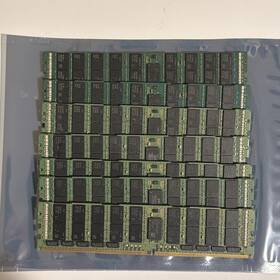
( Brand: Samsung ), ( Manufacturer Part Number: M386A8K40CM2-V20 ), ( Model: SAMSUNG PC4-2666 M386A8K40CM2-V20 ), ( Form Factor: Lrdimm ), ( Type: Ddr4 Sdram ), ( Total Capacity: 64 Gb ), ( Unit Type: Unit ), ( Manufacturer Warranty: Lifetime ), ( Number Of Pins: 288 ), ( Bus Speed: Pc4-21300 ), ( Memory Features: Ecc Memory, Registered )
Review SAMSUNG 64 Gb Lrdimm Ram Ddr4 Ecc Registered
The **Samsung M386A8K40CM2-V20 64GB DDR4 LRDIMM ECC Registered Memory Module** is a high-performance, enterprise-grade solution designed to meet the demanding requirements of modern data centers, high-end workstations, and mission-critical servers. Engineered with Samsung s proprietary **Low Power Double Data Rate 4 (LPDDR4) technology**, this module delivers exceptional speed and efficiency while maintaining reliability in demanding environments. With a **64GB capacity** (comprising two 32GB DIMMs), it provides ample memory bandwidth to support complex workloads, including virtualization, high-performance computing (HPC), and large-scale database operations. The **PC4-2666** specification ensures a robust data transfer rate of **2666 MT/s**, enabling seamless multitasking and rapid data processing, which is essential for applications requiring low latency and high throughput.
As a **Registered (RDIMM) module**, this memory module incorporates a **register buffer** that helps mitigate signal integrity issues on longer memory channels, reducing the risk of data corruption and improving stability in multi-socket server configurations. This makes it an ideal choice for servers with multiple CPU sockets, where signal integrity and error correction are paramount. The **ECC (Error-Correcting Code) functionality** further enhances reliability by automatically detecting and correcting single-bit errors, ensuring data integrity even under heavy workloads or prolonged operation. This feature is particularly valuable in environments where uptime and accuracy are non-negotiable, such as financial trading systems, cloud infrastructure, or scientific research platforms.
Built with **Samsung s advanced 16nm process technology**, these DIMMs offer a balance of performance and power efficiency, reducing energy consumption while maintaining peak performance. The **Low Power (LP) variant** of DDR4 technology is optimized for lower power draw compared to standard DDR4, making it an eco-friendly choice for data centers looking to minimize operational costs and carbon footprint. The module s **288-pin DIMM form factor** ensures compatibility with a wide range of enterprise-grade server platforms, including those from Dell, HP, Lenovo, and other major manufacturers, while adhering to strict industry standards for interoperability.
Whether deployed in a **2U server, blade system, or high-density rack setup**, this memory module excels in environments where scalability and performance are critical. Its **240-pin LRDIMM design** (with two 32GB DIMMs) allows for flexible memory expansion, enabling administrators to scale capacity incrementally as workload demands grow. The module s **low latency and high bandwidth** ensure that applications such as AI/ML training, real-time analytics, or virtual desktop infrastructure (VDI) operate with optimal efficiency, reducing bottlenecks and improving overall system responsiveness. Additionally, Samsung s rigorous quality control and compliance with **JEDEC standards** guarantee long-term reliability, with a robust lifespan suitable for round-the-clock operation in demanding environments.
For IT professionals and system architects seeking a **premium, high-capacity memory solution**, the **Samsung M386A8K40CM2-V20** stands out as a versatile and dependable choice. Its combination of **speed, error correction, power efficiency, and enterprise-grade reliability** makes it a cornerstone for next-generation computing infrastructure, ensuring that even the most resource-intensive applications run smoothly without compromise. Whether deployed in a **high-performance computing cluster, a virtualized data center, or a mission-critical enterprise server**, this memory module delivers the performance and stability required to keep modern IT environments running at peak efficiency.
The **Samsung M386A8K40CM2-V20 (64GB, DDR4-2666, ECC, LRDIMM)** is a high-end server-grade memory module designed for enterprise and workstation use. Below is a detailed breakdown of its pros and cons, followed by a conclusion and recommendation.
---
### **Pros**
1. **Enterprise-Grade Reliability**
- Built for servers and high-availability workstations, this module is designed to withstand prolonged use in demanding environments. Samsung s manufacturing standards ensure low error rates and long-term stability.
2. **ECC (Error-Correcting Code) Memory**
- ECC memory detects and corrects single-bit errors, which is critical for data integrity in servers, databases, and virtualization workloads. This reduces the risk of crashes caused by memory corruption.
3. **LRDIMM (Load-Reduced DIMM) Technology**
- LRDIMMs are optimized for multi-channel memory configurations, allowing for larger memory capacities (e.g., 128GB per DIMM slot) without overloading the memory controller. This is ideal for servers with high memory requirements.
- Supports registered (RDIMM) functionality, which helps manage signal integrity in high-speed memory channels.
4. **High Capacity (64GB per Module)**
- A single DIMM provides 64GB of memory, significantly reducing the number of slots needed to achieve large-scale configurations (e.g., 256GB 1TB in a server). This simplifies cable management and reduces power consumption per GB.
5. **DDR4-2666 Speed**
- While not the fastest DDR4 speed (e.g., DDR4-3200 or DDR4-4000), 2666MHz is sufficient for most server workloads, including virtualization, databases, and general enterprise computing. It strikes a balance between performance and compatibility.
6. **Compatibility with Server Platforms**
- Designed for Intel Xeon and AMD EPYC CPUs, this module works seamlessly in enterprise-grade motherboards (e.g., Supermicro, Dell PowerEdge, HP ProLiant). It is also backward-compatible with many Xeon E5/E7 and Xeon Scalable platforms.
7. **Low Power Consumption**
- LRDIMMs are more power-efficient than UDIMMs (Unbuffered DIMMs) for high-capacity configurations, reducing cooling and power costs in data centers.
8. **Long Lifespan and Warranty**
- Samsung s server memory typically comes with extended warranties (often 3 5 years) and is built to last for years in high-stress environments.
9. **Scalability**
- Supports multi-DIMM configurations, allowing for easy upgrades to larger memory pools as workloads grow.
10. **Reduced Latency in Registered Configurations**
- Registered DIMMs (RDIMMs) help mitigate latency issues in multi-DIMM setups by buffering signals, which is beneficial for high-core-count CPUs.
---
### **Cons**
1. **High Cost**
- Server-grade memory, especially LRDIMMs, is significantly more expensive than consumer-grade UDIMMs. The price per GB is much higher, making it impractical for non-enterprise use (e.g., gaming PCs or home workstations).
2. **Limited Consumer Use Cases**
- While technically compatible with some high-end consumer motherboards (e.g., Intel X299 or AMD TRX40), most consumer platforms do not support LRDIMMs or require proprietary configurations. This limits its appeal to enthusiasts or those repurposing server parts.
3. **Complex Installation**
- LRDIMMs require careful handling to avoid static damage and proper seating in the motherboard s registered memory slots. Non-technical users may struggle with installation or compatibility checks.
4. **Overkill for Most Workloads**
- Unless you re running a database server, virtualization host, or high-performance computing (HPC) workload, 64GB per DIMM is excessive. For most consumer or small-business needs, smaller capacities (e.g., 16GB 32GB UDIMMs) are sufficient and far cheaper.
5. **Compatibility Risks**
- Not all server motherboards support LRDIMMs at DDR4-2666. Some may require manual BIOS adjustments or specific chipset support. Always verify compatibility with your platform before purchasing.
6. **No Overclocking or XMP Support**
- Like all server memory, this module does not support overclocking or XMP profiles. Performance is locked to the specified speed (2666MHz).
7. **Bulk Purchase Necessity**
- Server memory is often sold in bulk (e.g., 4x or 8x modules per order), which may not be cost-effective for small-scale deployments. Buying single modules can be expensive.
8. **Potential for Redundancy**
- In some configurations, LRDIMMs may not provide a performance advantage over UDIMMs for smaller memory setups, as the registered buffering adds minimal latency benefits unless scaling to very large capacities.
---
### **Conclusion**
The **Samsung M386A8K40CM2-V20 (64GB DDR4-2666 ECC LRDIMM)** is an excellent choice for **enterprise servers, virtualization hosts, database servers, and high-end workstations** where reliability, scalability, and data integrity are paramount. Its ECC and LRDIMM features make it ideal for environments where uptime and performance are critical, such as data centers or mission-critical applications.
However, for **consumer use, gaming, or non-server workloads**, this module is overkill and far too expensive. In such cases, standard DDR4 UDIMMs (e.g., 16GB 32GB) would be a more practical and cost-effective alternative. Additionally, users must ensure their platform supports LRDIMMs and DDR4-2666 before purchasing.
---
### **Recommendation**
- **Buy this module if:**- You are building or upgrading a **server** (e.g., Dell PowerEdge, HP ProLiant, Supermicro) for virtualization, databases, or HPC.
- You need **high-capacity, reliable memory** for enterprise workloads where ECC and LRDIMM support are required.
- You are scaling memory to **large capacities (256GB )** and want to minimize the number of DIMMs.
- **Avoid this module if:**- You are using a **consumer motherboard** (e.g., Intel B560, AMD B550) or a non-server platform.
- Your workload does not require **ECC memory** (e.g., gaming, content creation without virtualization).
- You are on a **tight budget**, as the cost per GB is prohibitive for non-enterprise use.
- You need **higher speeds** (e.g., DDR4-3200 or DDR5) for performance-critical applications.
For most users outside of enterprise environments, prioritize **compatibility, cost, and workload requirements** before investing in high-end server memory. If you re unsure, consult your motherboard s documentation or a system integrator to confirm support.
Details:
Stressed test with meatiest. In working condition.
part #: m386a8k40cm2v20 prices
- $170.00-$3200.00
specifications servermemor:
- brand: Samsung
- mpn: M386a8k40cm2-v20
- model: Samsung Pc4-2666 M386a8k40cm2-v20
- form factor: Lrdimm
- type: Ddr4 Sdram
- total capacity: 64 Gb
- unit type: Unit
- manufacturer warranty: Lifetime
- number of pins: 288
- bus speed: Pc4-21300
- memory features: Ecc Memory, Registered
returns servermemor:
- policy: No Returns
payments servermemor:
- other
- credit card: Visa
- wallet: Paypal
offer servermemor:
- sold: 0
- best offers: True
- started: June 7, 2026
- availability: In Stock
- options: Ship-to-home
- quantity: 1
shipping servermemor:
- cost: $5.48
- type: Calculated
- transit: 3-6 Days
- service: USPS Ground Advantage
- carrier: USPS
- class: Standard
seller servermemor:
- rating: 100.0%
- # reviews: 442
- city: Deerfield, Illinois
general servermemor:
- Enterprise Networking, Servers > Server Components > Server Memory RAM
- condition: Used
Samsung M386A8K40CM2-V20 Is Similar To:
- 0.09744922496769814 Samsung Ecc Reg Ram (27.5% similar) No other accessories hardware software. I'll get back to you as soon I can...(November 17th, 2018)
- 0.11338225633667265 Lot Samsung Ecc Server Ram Memory (30.9% similar) Condition: used, working if a power adapter is required for this item, it not included cord shows signs of normal use w some scuffs scratches blemishes sticker residue no other accessories hardware software. I'll get back to you as soon I can...(March 27th, 2018)
- 0.1258726855836516 Lot Samsung Server Vlp Ram Ibm (23.5% similar) I'll get back to you as soon I can. Condition: used, working, pictured one but total 36 same if a power adapter is required for this item, it not included cord shows signs of normal use w some scuffs scratches blemishes sticker residue no other accessories hardware software...(October 19th, 2018)
- 0.35100209741590715 Hp Samsung Ecc Reg (27.8% similar) I'll get back to you as soon I can. No other accessories hardware software...(October 12th, 2018)
- 0.3518165772947017 Samsung Cn Ram Ecc Reg Qty (36.5% similar) No other accessories hardware software. I'll get back to you as soon I can...(May 7th, 2018)
- 0.4190561585571104 Lot Samsung Ecc Server Ram (26.1% similar) Condition: used, working if a power adapter is required for this item, it not included cord shows signs of normal use w some scuffs scratches blemishes sticker residue no other accessories hardware software. I'll get back to you as soon I can...(October 13th, 2018)
- 0.4196896457027133 Samsung Ecc Reg Ram (27.8% similar) No other accessories hardware software. I'll get back to you as soon I can...(November 9th, 2018)
- 0.42639317034624824 Samsung Server Vlp Ram Ibm (24.1% similar) I'll get back to you as soon I can. Condition: used, working if a power adapter is required for this item, it not included cord shows signs of normal use w some scuffs scratches blemishes sticker residue no other accessories hardware software...(October 19th, 2018)
- 0.7823584412062607 Samsung Reg Ecc Ram Cn Qty (27.8% similar) I'll get back to you as soon I can. No other accessories hardware software...(June 19th, 2018)
- 0.850481806304197 Lot Samsung Hynix Server Ecc Ram (28.3% similar) Condition: used, working if a power adapter is required for this item, it not included cord shows signs of normal use w some scuffs scratches blemishes sticker residue no other accessories hardware software. I'll get back to you as soon I can...(October 16th, 2018)
- 0.9516050138760368 Samsung Registered Ecc Memory (30.5% similar) Condition: used, working if a power adapter is required for this item, it not included cord shows signs of normal use w some scuffs scratches blemishes sticker residue no other accessories hardware software. I'll get back to you as soon I can...(May 26th, 2018)