INNODISK M4DE-AGS2P50M-AU48 Sdram Ecc Memory Dimm 32GB DDR4-3200 2X16GB
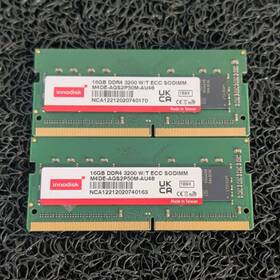
( Brand: Innodisk ), ( Manufacturer Part Number: M4DE-AGS2P50M-AU48 ), ( Form Factor: So-dimm ), ( Type: Ddr4 Sdram ), ( Total Capacity: 32 Gb ), ( Capacity Per Module: 16 Gb ), ( Number Of Pins: 260 ), ( Bus Speed: Ddr4-3200 ), ( Memory Features: Ecc Memory )
Review INNODISK Ddr4-3200 Ddr4 Sdram Ecc Memory So dimm 2x16gb
The **InnoDisk M4DE-AGS2P50M-AU48 32GB DDR4-3200 ECC SO-DIMM (2x16GB)** is a high-performance, enterprise-grade memory module designed to deliver exceptional reliability, speed, and efficiency for demanding computing environments. Engineered with precision, this **2-rank, 240-pin SO-DIMM** module features **32GB of DDR4 SDRAM** (configured as two 16GB DIMMs in a dual-rank configuration) to maximize data throughput and system responsiveness. Operating at a robust **DDR4-3200 MHz** clock speed, it ensures blazing-fast data transfer rates, making it ideal for applications requiring real-time processing, such as embedded systems, industrial computing, and high-performance storage solutions. The inclusion of **ECC (Error-Correcting Code) technology** further enhances data integrity by detecting and correcting single-bit errors on the fly, which is critical for mission-critical applications where uptime and accuracy are non-negotiable.
Built to meet stringent industrial standards, this module is designed for durability and stability, featuring **low-power consumption** and **high signal integrity** to minimize latency and power draw. The **240-pin SO-DIMM form factor** makes it compatible with a wide range of compact and portable systems, including ruggedized laptops, mini-PCs, embedded servers, and IoT devices, where space efficiency and performance are paramount. The module s **unbuffered architecture** ensures seamless integration with most modern motherboards and chipsets, while its **low-profile design** allows for easy installation in constrained environments. Whether deployed in data centers, automotive systems, or aerospace applications, this memory module provides a reliable foundation for high-speed data processing, ensuring optimal performance under even the most demanding workloads.
The **InnoDisk M4DE-AGS2P50M-AU48** is a 32GB DDR4-3200 ECC SO-DIMM memory module designed for embedded systems, industrial PCs, and rugged computing environments. Below is a detailed analysis of its pros and cons, followed by a conclusion and recommendation.
---
### **Pros**
1. **ECC Memory for Data Integrity**
The module features **ECC (Error-Correcting Code) memory**, which detects and corrects single-bit errors in real time. This is critical for applications where data corruption could lead to catastrophic failures, such as industrial automation, medical devices, or financial systems. ECC reduces the risk of silent data corruption, which is a significant advantage in mission-critical environments.
2. **High Performance with DDR4-3200**
DDR4-3200 provides **faster data transfer rates** compared to older DDR3 or slower DDR4 modules, improving system responsiveness and throughput. This is beneficial for applications requiring real-time processing, such as video surveillance, AI inference, or high-speed data logging.
3. **Rugged and Reliable Design**
InnoDisk is known for producing **industrial-grade memory**, which is built to withstand harsh conditions. This module is likely **compliant with standards such as MIL-STD-883, AEC-Q100, or other rugged certifications**, making it suitable for environments with temperature extremes, vibration, or electromagnetic interference. This reliability is essential for embedded systems deployed in factories, outdoor kiosks, or military applications.
4. **Low Power Consumption**
DDR4 modules generally consume less power than DDR3, contributing to **longer battery life in mobile or battery-powered systems**. This is advantageous for edge computing devices or IoT applications where power efficiency is a concern.
5. **Compatibility with Embedded Systems**
The **SO-DIMM form factor** ensures compatibility with a wide range of **embedded motherboards, mini-ITX boards, and rugged PCs** (e.g., Advantech, Kontron, or Dell Embedded systems). This makes it a versatile upgrade option for systems where additional memory is needed but space is limited.
6. **Long-Term Availability and Support**
InnoDisk is a well-established manufacturer with a reputation for **long-term product availability**, which is crucial for industries where hardware must remain supported for years. This reduces the risk of obsolescence compared to lesser-known brands.
7. **Security Features (Optional)**
Some ECC modules support **memory encryption or secure boot features**, depending on the system s BIOS/UEFI. While this module itself may not include encryption, the ECC protection adds an extra layer of security against data tampering.
8. **Cost-Effective for High-Reliability Needs**
While ECC memory is more expensive than non-ECC, the **cost per gigabyte is justified in environments where uptime and data integrity are non-negotiable**. For applications where downtime could result in financial loss or safety risks, the investment in ECC pays off.
---
### **Cons**
1. **Higher Cost Compared to Non-ECC Memory**
ECC memory is **significantly more expensive** than standard DDR4 modules. For example, a 32GB DDR4-3200 non-ECC module might cost **$30 $50**, whereas this ECC module could range from **$100 $150 or more**, depending on quantity and supplier. This makes it a **poor choice for consumer or gaming PCs** where ECC is unnecessary.
2. **Limited Capacity Options**
The module is **only 32GB**, which may be insufficient for modern workloads requiring larger memory pools (e.g., AI training, large databases, or virtualization). If the system supports dual-channel, you might need **two of these modules (64GB total)**, which doubles the cost. For high-end embedded systems, you may need to pair it with larger-capacity modules from the same vendor.
3. **Vendor Lock-In Risk**
While InnoDisk is reliable, **SO-DIMM modules are often proprietary** in terms of pinout or timing configurations. If the motherboard has **strict memory compatibility requirements**, there may be limited alternatives, increasing dependency on InnoDisk s support.
4. **Potential Latency Overhead**
ECC introduces **minor latency** due to error-checking and correction logic. In **latency-sensitive applications** (e.g., real-time control systems or high-frequency trading), this overhead may be negligible, but it s worth noting for ultra-low-latency requirements.
5. **Not Upgradable in All Systems**
Some embedded motherboards **lock memory slots** or restrict upgrades to specific vendors. Before purchasing, verify that the module is **compatible with your system s BIOS/UEFI** and that the manufacturer supports it.
6. **Limited Availability of Mixed-Sized Modules**
If the system already has memory installed, you may need **matched pairs** (e.g., two 16GB modules) to avoid performance degradation due to uneven memory channels. This can complicate upgrades.
7. **No Overclocking Support**
Like most industrial memory, this module **does not support overclocking**. If you need higher speeds (e.g., DDR4-3600), you ll need a different module, which may not be available in ECC variants.
---
### **Conclusion**
The **InnoDisk M4DE-AGS2P50M-AU48 32GB DDR4-3200 ECC SO-DIMM** is an **excellent choice for industrial, embedded, or rugged computing applications** where **data integrity, reliability, and long-term stability** are critical. Its ECC protection, high performance, and rugged design make it ideal for:
- **Industrial automation** (PLCs, SCADA systems)
- **Medical devices** (imaging, patient monitoring)
- **Financial systems** (high-availability servers)
- **Military/aerospace applications**
- **Edge computing** (IoT gateways, surveillance systems)
However, it is **overkill and unnecessarily expensive** for:- **Consumer PCs, gaming rigs, or workstations** (non-ECC DDR4 is sufficient)
- **Applications with minimal memory requirements** (e.g., single-board computers running lightweight OSes)
- **Budget-conscious projects** where ECC is not a priority
If you re working in a **mission-critical embedded environment**, this module is a **strong recommendation** due to its reliability and performance. If you re in a **non-critical or cost-sensitive** scenario, consider non-ECC alternatives.
---
### **Recommendation**
**Buy this module if:**- You are deploying it in an **industrial, medical, or military system** where uptime and data integrity are non-negotiable.
- Your system **requires ECC support** (e.g., Linux servers, real-time OSes like QNX or VxWorks).
- You need **rugged, long-term reliable memory** in a **temperature/vibration-resistant environment**.
- Your workload benefits from **DDR4-3200 speeds** (e.g., video processing, AI inference).
**Avoid this module if:**- You are building a **consumer PC, gaming rig, or workstation** (non-ECC DDR4 is cheaper and sufficient).
- Your budget is tight, and you can tolerate occasional memory errors (non-ECC is fine for most non-critical applications).
- You need **larger memory capacities** (e.g., 64GB ), as this module is only 32GB.
- You require **overclocking or non-standard memory speeds** (this is a standard industrial module).
**Alternatives to Consider:**- For **non-ECC needs**, look for **Crucial, Kingston, or Samsung SO-DIMM modules** (cheaper, widely available).
- For **higher capacities**, check InnoDisk s **larger ECC SO-DIMM options** (e.g., 64GB, 128GB).
- For **ultra-rugged environments**, verify if the module meets **MIL-STD-883 or AEC-Q100** standards (some InnoDisk modules do, but confirm specs).
**Final Verdict:**This is a **premium industrial-grade memory module** justified by its niche but critical applications. For most other use cases, it is **not cost-effective**. Always **verify compatibility with your motherboard** before purchasing.
Details:
Innodisk 32GB DDR4-3200 DDR4 SDRAM ECC Memory SO-DIMM 2x16GB Innodisk.
part #: m4deags2p50mau48 prices
- $115.00-$149.95
specifications servermemor:
- brand: Innodisk
- mpn: M4de-ags2p50m-au48
- form factor: So-dimm
- type: Ddr4 Sdram
- total capacity: 32 Gb
- capacity per module: 16 Gb
- number of pins: 260
- bus speed: Ddr4-3200
- memory features: Ecc Memory
offer servermemor:
- options: Ship-to-home
- best offers: True
- started: March 31, 2026
- availability: In Stock
- sold: 0
- quantity: 6
general servermemor:
- Enterprise Networking, Servers > Server Components > Server Memory RAM
- condition: Used
payments servermemor:
- other
- credit card: Diners-club
- wallet: Paypal
seller servermemor:
- rating: 100.0%
- # reviews: 6
- city: Frederick, Maryland
returns servermemor:
- policy: No Returns
shipping servermemor:
- type: Calculated
- cost: $5.52
- transit: 4-10 Days
- class: Standard
- service: USPS Ground Advantage
- carrier: USPS
Innodisk M4DE-AGS2P50M-AU48 Is Similar To:
- Act16ghr72u4j1866s Innodisk Actica Reg Ecc Samsung Chip (29.9% similar) ...(March 27th, 2019)
- M3cw-4ghj3c0c-es Innodisk Dimm (23.9% similar) M3CW-4GHJ3C0C-ES 4GB DDR3 w ecc dimm...(June 2nd, 2018)
- M4c 8g22mc0j-e Innodisk Ecc Dimm Dram Server Memory (36.6% similar) Works great - came out of a re-purposed unit. Selling an 8GB stick of Innodisk DDR4-2400 ecc dram...(May 8th, 2018)
- M4r0-8gsqecrg Actica Innodisk Reg Ecc Memory Used (37.5% similar) Sold as pictured the offer is for units only and listed, no any other accessories are included. The actual items shown in picture. Arctic 8GB DDR4 2133 reg ecc M4R0-8GSQECRG memory used condition: pull from working unit...(March 12th, 2019)
- M4r0-agsqgcsj Innodisk Registered Ecc Server Ram (33.1% similar) It is DDR4 registered ecc server ram. Free shipping please let us know if there are any questions. Please if something comes up. Please through messaging system with any questions or concerns. Please through messaging system with any questions or concerns...(August 1st, 2018)
- M4r0-agsqgcrg Innodisk Ecc Registered Memory (30.9% similar) Pulled from working system. Shipped with USPS first class package. 2X16GB 2RX4 PC4-2133P DDR4 ecc registered memory...(May 13th, 2020)
- Innodisk Corp M4r0-ags3ecsj Used 16gb Ddr4-2400mhz 288-pin Dimm 1.2v Dual (44.7% similar) Used, Innodisk corp, M4R0-AGS3ECSJ, 16GB DDR4-2400MHZ 288-PIN dimm 1.2V dual rank...(January 27th, 2024)
- Innodisk M4r0-ags3ecrg 64gb 4x 16gb Ddr4-2133 Reg Ecc Server Memory Ram 99 (51.9% similar) Please review all photos for best. All products sold carry a full 30 day satisfaction guarantee. Location: DP/1. Contents: Innodisk M4R0-AGS3ECRG DDR4-2133 reg ecc server memory ram X4. Condition: pulled from a working server...(August 6th, 2024)
- Innodisk M3c0-8gms3lqe 8gb Ddr3l Server Memory M3c0-8gms3lqe-b054 1866mhz Pc3l Ecc Dimm Lot 8 (39.5% similar) Part #: Innodisk M3C0-8GMS3LQE for sale...(August 8th, 2024)
- Innodisk M4r0-8gs Lot Of 8 M4r0-8gs1acrg-b623 64gb 8x16gb Ddr4 2133 Server Memory (43.8% similar) Return exchange. Shipping handling. Lot of 8 Innodisk M4R0-8GS1ACRG-B623 64GB 8X16GB DDR4 2133 server memory. Whats included. No less, no more. You can ship by your FedEx account or using label...(August 22nd, 2024)
- Innodisk M4ri-ags1bc0k-c 2 X 16gb Ddr4-21300 Pc4-2666v-r Rdimm Memory (52.7% similar) Misc information. Original packaging must remain intact. Condition, used, warranty, 30-DAY warranty. Not available for this item. Innodisk 2 x 16GB DDR4-21300 PC4-2666V-R dimm memory M4RI-AGS1BC0K-C...(August 22nd, 2024)