SAMSUNG MR16R162GDF0-CT9 Dimm Server Ram 512MB DDR2 240-PIN 1066-32P
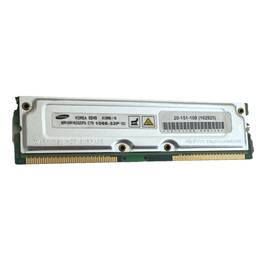
( Brand: Samsung ), ( Manufacturer Part Number: MR16R162GDF0-CT9 ), ( Form Factor: Fb-dimm ), ( Type: Ddr2 Fb-dimm Sdram ), ( Total Capacity: 512 Mb ), ( Number Of Pins: 240 ), ( Bus Speed: 1066-32p ), ( Memory Features: Fully Buffered )
Review SAMSUNG 512mb Fb dimm 240-pin Server Ram
The **Samsung M16R162GDF0-CT9** is a high-performance, low-latency **512MB DDR2 FB-DIMM memory module** engineered specifically for enterprise-grade server applications, delivering uncompromising reliability and efficiency in demanding computing environments. Designed to operate within the **240-pin FB-DIMM (Fully Buffered DIMM) architecture**, this module adheres to strict industry standards, ensuring seamless integration into high-end server platforms that support dual-channel or multi-channel memory configurations. With a **1066 MHz (PC2-8500) data transfer rate**, it maximizes bandwidth and throughput, enabling faster data processing, improved multitasking, and enhanced system responsiveness critical for workloads such as virtualization, database management, and high-performance computing. The **512MB capacity** strikes a balance between cost-effectiveness and performance, making it an ideal choice for mid-range servers where memory density is a consideration without sacrificing speed.
Built with **Samsung s proprietary memory technology**, this module incorporates **low-power, high-reliability DRAM chips** that operate efficiently within a **1.8V voltage range**, reducing heat generation and extending the lifespan of both the memory itself and the server hardware. The **FB-DIMM design** further enhances stability by buffering signals through a dedicated memory buffer chip, which minimizes data corruption risks and improves error correction capabilities particularly beneficial in large-scale server deployments where data integrity is paramount. Compatible with **Intel Xeon and AMD Opteron processors** (among other high-end CPUs), this module is engineered to work flawlessly in enterprise servers from leading manufacturers, including Dell PowerEdge, HP ProLiant, and IBM xSeries systems, ensuring broad compatibility across a wide range of server architectures.
Beyond its technical specifications, the **M16R162GDF0-CT9** exemplifies Samsung s commitment to **enterprise-grade durability and longevity**, featuring **ECC (Error-Correcting Code) support** to detect and automatically correct single-bit errors, reducing the risk of system crashes or data loss in mission-critical applications. Its **low-profile, rugged construction** ensures resistance to environmental stressors, making it suitable for data centers with varying temperature and humidity conditions. Whether deployed in a **virtualized environment, a high-transaction database server, or a clustered computing setup**, this memory module delivers consistent performance, scalability, and reliability making it a trusted component for organizations prioritizing both efficiency and uptime. For IT administrators and system architects seeking a balance of speed, stability, and cost-efficiency, the **Samsung M16R162GDF0-CT9** stands as a dependable solution for powering next-generation server infrastructure.
### **Pros and Cons of buying a Samsung MR16R162GDF0-CT9 (512MB DDR2 FB-DIMM 240-pin 1066MHz Server RAM)**
#### **Pros:**1. **Compatibility with Older Server Systems** DDR2 memory is still widely used in legacy servers, workstations, and older enterprise hardware, making this a practical choice for upgrading or maintaining older systems.
2. **Reliability for Basic Server Workloads** While 512MB per module is small by modern standards, it can still handle lightweight tasks such as file servers, basic database operations, or legacy applications where memory demands are low.
3. **Cost-Effective for Budget Constraints** DDR2 RAM is significantly cheaper than newer generations (DDR3, DDR4, DDR5), making it a budget-friendly option for users who don t need high-performance memory.
4. **ECC Support (if applicable)** Some DDR2 modules (including Samsung s server-grade parts) may support Error-Correcting Code (ECC), which helps prevent data corruption in critical applications.
5. **Long-Term Availability** Since DDR2 is an older standard, these modules are still produced and can be found in stock, reducing the risk of obsolescence compared to newer, harder-to-source memory types.
6. **Low Power Consumption** DDR2 modules consume less power than newer generations, which can be beneficial for older power-hungry systems where efficiency matters.
#### **Cons:**1. **Extremely Low Capacity** 512MB per module is insufficient for modern workloads. Even a single modern application (e.g., a database, virtual machine, or cloud service) will require far more memory, making this impractical for anything beyond the most basic tasks.
2. **Limited Performance** DDR2 operates at 1066MHz, which is slow compared to modern standards (e.g., DDR4-3200 or DDR5-4800). This will bottleneck performance in any system that isn t already constrained by other components.
3. **No Future-Proofing** If the server is intended for long-term use, upgrading to DDR3 or DDR4 later will require replacing the entire memory subsystem, as they are incompatible.
4. **High Per-Unit Cost When Scaling** While individual modules are cheap, achieving even modest memory capacity (e.g., 4GB or 8GB) would require multiple modules, increasing the total cost without meaningful benefit.
5. **Potential Compatibility Issues** Some newer motherboards or CPUs may not support DDR2, even if the system is otherwise compatible. Always verify compatibility with the specific server model.
6. **No Support for Modern Features** DDR2 lacks advanced features like low-power modes, higher bandwidth, or support for newer CPU architectures, limiting its usefulness in modern environments.
---
### **Conclusion:**The **Samsung MR16R162GDF0-CT9 (512MB DDR2 FB-DIMM)** is a niche product best suited for **legacy systems, hobbyist projects, or very low-end server applications** where memory demands are minimal. It is **not a practical choice** for modern workloads, cloud computing, virtualization, or any environment requiring more than a few hundred megabytes of RAM.
If you are working with an **older server that absolutely cannot use newer memory**, this module may serve as a stopgap solution. However, for any other use case, investing in **modern DDR4 or DDR5 memory** (even if it requires upgrading the entire system) will provide far better performance, scalability, and future compatibility.
---
### **Recommendation:** - **Buy this module only if:**- You are maintaining a **legacy server** (e.g., a 2005-2010-era Intel Xeon or AMD Opteron system) that **explicitly requires DDR2**.
- You are running **extremely lightweight applications** (e.g., a file server for a small office, a basic web server, or a legacy database with minimal data).
- You are on a **tight budget** and cannot upgrade the entire system.
- **Avoid this module if:**- You are working with a **modern server** (post-2015) or any system that supports DDR3/DDR4/DDR5.
- Your workload requires **more than a few hundred megabytes of RAM**.
- You plan to **scale the system in the future**, as DDR2 will become obsolete and incompatible.
- You need **ECC memory** (check if this specific module supports it, as not all 512MB DDR2 modules do).
#### **Better Alternatives:**- For **legacy systems**, consider **used or refurbished DDR3/DDR4 modules** if the motherboard supports them.
- For **modern servers**, invest in **DDR4-2400 or DDR5-4800 ECC RAM** (e.g., 16GB or 32GB modules) for optimal performance.
- If budget is a concern, **used enterprise-grade memory** (e.g., from Dell, HP, or Lenovo servers) can often be found at a fraction of the cost of new modules.
Details:
With a total capacity of 512MB spread across single module, this DDR2 FB-DIMM SDRAM offers fast bus speed and fully buffered memory features for reliable performance. The 240-pin design ensures compatibility with a wide range of server systems, making it versatile choice for enhancing efficiency and speed. The Samsung 512MB DDR2 FB-DIMM 240-Pin 1066-32P Server RAM MR16R162GDF0-CT9 is a high-quality memory module designed for server use.
part #: mr16r162gdf0ct9 prices
- $14.99-$40.00
specifications servermemor:
- brand: Samsung
- mpn: Mr16r162gdf0-ct9
- form factor: Fb-dimm
- type: Ddr2 Fb-dimm Sdram
- total capacity: 512 Mb
- number of pins: 240
- bus speed: 1066-32p
- memory features: Fully Buffered
returns servermemor:
- policy: No Returns
seller servermemor:
- # reviews: 20
- city: Tarzana, California
- rating: 100.0%
shipping servermemor:
- service: USPS Ground Advantage
- cost: $0.00
- transit: 5-11 Days
- type: Calculated
- class: Standard
- carrier: USPS
offer servermemor:
- started: April 30, 2026
- availability: In Stock
- best offers: True
- sold: 0
- options: Ship-to-home
- quantity: 2
payments servermemor:
- wallet: Google-pay
- other
- money order
- credit card: Discover
general servermemor:
- condition: Used
- Enterprise Networking, Servers > Server Components > Server Memory RAM
Samsung MR16R162GDF0-CT9 Is Similar To:
- 0.09744922496769814 Samsung Ecc Reg Ram (27.3% similar) No other accessories hardware software. I'll get back to you as soon I can...(November 17th, 2018)
- 0.11338225633667265 Lot Samsung Ecc Server Ram Memory (32.3% similar) Condition: used, working if a power adapter is required for this item, it not included cord shows signs of normal use w some scuffs scratches blemishes sticker residue no other accessories hardware software. I'll get back to you as soon I can...(March 27th, 2018)
- 0.1258726855836516 Lot Samsung Server Vlp Ram Ibm (30% similar) I'll get back to you as soon I can. Condition: used, working, pictured one but total 36 same if a power adapter is required for this item, it not included cord shows signs of normal use w some scuffs scratches blemishes sticker residue no other accessories hardware software...(October 19th, 2018)
- 0.3518165772947017 Samsung Cn Ram Ecc Reg Qty (22.4% similar) No other accessories hardware software. I'll get back to you as soon I can...(May 7th, 2018)
- 0.4190561585571104 Lot Samsung Ecc Server Ram (34.5% similar) Condition: used, working if a power adapter is required for this item, it not included cord shows signs of normal use w some scuffs scratches blemishes sticker residue no other accessories hardware software. I'll get back to you as soon I can...(October 13th, 2018)
- 0.4196896457027133 Samsung Ecc Reg Ram (27.5% similar) No other accessories hardware software. I'll get back to you as soon I can...(November 9th, 2018)
- 0.42639317034624824 Samsung Server Vlp Ram Ibm (30.8% similar) I'll get back to you as soon I can. Condition: used, working if a power adapter is required for this item, it not included cord shows signs of normal use w some scuffs scratches blemishes sticker residue no other accessories hardware software...(October 19th, 2018)
- 0.7823584412062607 Samsung Reg Ecc Ram Cn Qty (22.4% similar) I'll get back to you as soon I can. No other accessories hardware software...(June 19th, 2018)
- 0.850481806304197 Lot Samsung Hynix Server Ecc Ram (33.1% similar) Condition: used, working if a power adapter is required for this item, it not included cord shows signs of normal use w some scuffs scratches blemishes sticker residue no other accessories hardware software. I'll get back to you as soon I can...(October 16th, 2018)
- 0.9685219361416628 Lot Samsung Server Vlp Ram (31% similar) Condition: used, working, pictured one but total 32 same if a power adapter is required for this item, it not included cord shows signs of normal use w some scuffs scratches blemishes sticker residue no other accessories hardware software. I'll get back to you as soon I can...(October 20th, 2018)
- 0.9709607809767642 Samsung Micron Server Vlp Ram Ibm (35.8% similar) I'll get back to you as soon I can. Condition: used, working if a power adapter is required for this item, it not included cord shows signs of normal use w some scuffs scratches blemishes sticker residue no other accessories hardware software...(October 20th, 2018)