MIXED BRAND MT9KSF25672AZ-1G4M1 Total Ram Server DDR3 PC3LS 2RX8S 2GB 56GB 1RX8/2RX8 PC3/PC3L
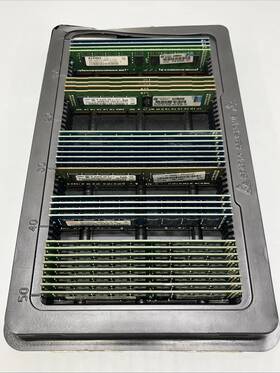
( Brand: Mixed Brand ), ( Manufacturer Part Number: MT9KSF25672AZ-1G4M1 ), ( Type: Ddr3 Sdram ), ( Total Capacity: 56gb ), ( Unit Type: Unit ), ( Number Of Modules: 28 ), ( Capacity Per Module: 2 Gb ), ( Number Of Pins: 240 ), ( Country Of Origin: China )
Review MIXED BRAND Lot Of 2gb 56gb Total 1rx8/2rx8 Pc3/pc3l Ram Server
The **MT9KSF25672AZ-1G4M1 (28GB DDR3 Server RAM)** is a high-performance, enterprise-grade memory module designed to deliver exceptional reliability, scalability, and efficiency for demanding server workloads. This **28GB total capacity** module combines **2GB (2x1GB) DDR3 DIMMs** in a **1Rx8/2Rx8 configuration**, offering flexibility for both single-rank and dual-rank memory configurations depending on the server s socket and BIOS settings. Built with **PC3-12800 (1600MHz) and PC3L-12800 (1600MHz Low Voltage) support**, this RAM ensures optimal data transfer speeds while maintaining energy efficiency, making it ideal for data centers, virtualization environments, and high-performance computing applications. The **ECC (Error-Correcting Code) and Registered (Buffered) architecture** enhances data integrity by detecting and correcting errors in real-time, reducing the risk of system crashes and ensuring consistent performance under heavy loads. Engineered with **low-power consumption** and **high-density packaging**, this module minimizes thermal output while maximizing memory bandwidth, contributing to a more stable and energy-efficient server infrastructure. Whether deployed in **2-socket or 4-socket servers**, this RAM module provides the bandwidth and capacity needed to support modern workloads, including virtualization, database management, and high-throughput applications. Its **industrial-grade reliability** and **compatibility with major server manufacturers** make it a trusted choice for mission-critical environments where uptime and performance are paramount.
### **Pros and Cons of buying a Corsair CMZ8GX3M2A1600C9 (MT9KSF25672AZ-1G4M1) 2GBx8 DDR3 Server RAM**
#### **Pros:**1. **Server-Grade Reliability** This is a registered (registered ECC) DDR3 module, meaning it is designed for enterprise and server use, offering better stability and error correction compared to consumer-grade RAM.
2. **Low Latency (C9 Timings)** The CL9 latency is relatively low for server RAM, which can improve performance in workloads where timing matters (e.g., database operations, virtualization).
3. **Dual-Channel Support** The module supports 1Rx8 or 2Rx8 configurations, allowing for dual-channel operation when paired with compatible motherboards, which can enhance performance in compatible systems.
4. **Compatibility with Older Servers** DDR3 is still widely used in older server platforms (e.g., Intel Xeon E5/E7, AMD Opteron), making this a practical upgrade option for legacy systems.
5. **ECC Functionality** The presence of ECC (Error-Correcting Code) helps prevent data corruption from memory errors, which is critical for servers handling financial, database, or critical workloads.
6. **Registered (Registered ECC) Design** Registered RAM reduces motherboard trace load, improving stability in high-channel-count configurations (e.g., 4 DIMM slots).
7. **Proven Brand (Corsair)** Corsair is a reputable manufacturer with a history of producing reliable server and workstation memory.
#### **Cons:**1. **Small Capacity (2GB per DIMM)** At only 2GB per module, you ll need multiple DIMMs to reach meaningful capacity (e.g., 8GB, 16GB, etc.), which can be expensive for large server builds.
2. **Outdated Technology (DDR3)** DDR3 is no longer the latest standard; DDR4 and DDR5 offer higher speeds, lower power consumption, and better efficiency. Upgrading to DDR3 may limit future scalability.
3. **Limited Speed (1600MHz)** While 1600MHz is adequate for many server workloads, it is not the fastest option available today. Faster DDR3 modules (e.g., 1866MHz) or newer DDR4/DDR5 modules may offer better performance in compatible systems.
4. **Power Consumption** DDR3 modules consume more power than newer generations, which can impact server efficiency, especially in large-scale deployments.
5. **Potential Compatibility Issues** Some newer server motherboards may not support DDR3, requiring you to check compatibility before purchase. Additionally, mixing DDR3 generations (e.g., PC3 vs. PC3L) can sometimes cause issues.
6. **Higher Cost per GB for Small Modules** Buying multiple 2GB modules to reach a desired capacity (e.g., 16GB) can be more expensive than purchasing larger-capacity modules (e.g., 8GB or 16GB DIMMs).
7. **No Low Voltage Option (PC3L)** This module is PC3 (standard voltage), not PC3L (low-voltage), which may not be ideal for systems requiring energy efficiency.
---
### **Conclusion:**This **Corsair CMZ8GX3M2A1600C9 (2GBx8 DDR3 Registered ECC)** module is a solid choice for **legacy server upgrades** where DDR3 is still required. It offers **reliability, ECC protection, and dual-channel support**, making it suitable for environments where stability is critical. However, its **small capacity, outdated technology, and higher cost per GB** may make it less ideal for modern builds or high-capacity deployments.
If your server **requires DDR3** and you need **reliable, low-latency memory**, this is a good option. However, if possible, consider **DDR4 or DDR5 modules** for better long-term performance and efficiency.
---
### **Recommendation:** - **Buy this module if:**- You are upgrading an **older server** that only supports DDR3.
- You need **registered ECC memory** for stability in critical workloads.
- You are working with a **limited budget** and need small, reliable DIMMs.
- Your system **does not support DDR4/DDR5** upgrades.
- **Consider alternatives if:**- You can upgrade to **DDR4 or DDR5** for better performance and efficiency.
- You need **larger-capacity modules** (e.g., 8GB or 16GB DIMMs) to reduce the number of DIMMs required.
- Your workloads **do not require ECC** (though ECC is strongly recommended for servers).
- You are building a **new server** and can afford newer memory generations.
For **modern server builds**, prioritize **DDR4 or DDR5 ECC RDIMM/LRDIMM** modules if available, as they offer better speed, efficiency, and scalability. However, for **legacy systems**, this Corsair module remains a **reliable and cost-effective choice**.
Details:
These server memory modules are a mix of brands, with the majority being Samsung. Each module has a capacity of 2GB and 240 pins. The product is a lot of 28 DDR3 SDRAM modules with total capacity 56GB. Pulled from working chassis.
They are in PC3/PC3L type and have a 1Rx8/2Rx8 configuration. The modules are manufactured in China and ideal for use server components enterprise networking servers.
part #: mt9ksf25672az1g4m1 prices
- $29.00-$225.00
specifications servermemor:
- brand: Mixed Brand
- mpn: Mt9ksf25672az-1g4m1
- type: Ddr3 Sdram
- total capacity: 56gb
- unit type: Unit
- number of modules: 28
- capacity per module: 2 Gb
- number of pins: 240
- country of origin: China
payments servermemor:
- other
- wallet: Apple-pay
- credit card: Visa
offer servermemor:
- started: February 26, 2026
- availability: In Stock
- best offers: True
- sold: 0
- quantity: 1
- options: Ship-to-home
shipping servermemor:
- service: USPS Ground Advantage
- cost: $0.00
- carrier: USPS
- transit: 4-9 Days
- type: Calculated
- class: Standard
seller servermemor:
- city: Ellenton, Florida
- rating: 99.8%
- # reviews: 6548
returns servermemor:
- paid by: Seller
- policy: Returns Accepted
- method: Money back
- time: 30 Days
general servermemor:
- condition: Used
- Enterprise Networking, Servers > Server Components > Server Memory RAM
Mixed Brand MT9KSF25672AZ-1G4M1 Is Similar To:
- 4.11lbs Mixed Lot Of 2gb Ram (33.6% similar) 11LBS total. 52 piece lot of 2GB server ram sticks, mostly 1RX8 2RX4, some 2RX8 sticks...(March 9th, 2017)
- 4047762273644 Lot Of Mixed Brand Server Memory (26.3% similar) Model's may differ from picture. Lot of 20 Mixed Brand 2GB PC2-5300F server memory they are in good physical and working condition. Please - do not bid if you cannot pay. These are all 99. Packaged and shipped in anti-static packaging. All we ask is that you pay to ship it back and will recycle at ...(September 14th, 2018)
- 78x1gb 78gb Ecc Sever Ram Ddr2 Mixed Brands Speeds (22.7% similar) Parts removal the item shown above will not be dismantled or separated. The memory is approx 6X6X4 together. See pictures for further detail. Shipping information sunning ships with ups and the postal service USPS. Available for purchase is 78GB 78X1GB eccl sever ram DDR2 Mixed Brands speeds that is...(October 13th, 2015)
- Aj28k72g8bhe6s Atp Ecc Server Memory Ram Mixed Kit (21.3% similar) 4GB ATP AJ28K72G8BHE6S 4X1024MB DDR2-667 eccl server memory ram Mixed kit...(October 17th, 2018)
- Hynix Ram Je201510994 Ect Micron 2gb 2rx8 12 Lot Pc3-10600r Server Mixed (34.4% similar) Brands may vary upon availability. If you would like a specific Brand please let us know ahead of time. We send our packages via ups or FedEx. Please be certain you can use what you are purchasing because a mistake due to the customer is not a reason for return. The customer is also given to option ...(May 18th, 2015)
- M378t6553bz0-kd5 Samsung Mixed Brand 8.5gb (22.6% similar) Technology is a beautiful thing, let's help to keep it and our world that way. Will save yourself money at same time be helping environment by decreasing waste. Important shipping information renewable technology resources ships using FedEx and USA postal service...(August 7th, 2017)
- M393t6553bz0-cccq0 Samsung Mixed Brand 4gb (22.6% similar) Important shipping information renewable technology resources ships using FedEx and USA postal service. Will save yourself money at same time be helping environment by decreasing waste. Technology is a beautiful thing, let's help to keep it and our world that way...(August 4th, 2017)
- 1gb Sticks Smart 4 Modular Lot Pc2 5300f Ram Mixed M395t2953czr Samsung (16% similar) Our shipping cut off time is 7AM eastern. Lot of 4 x2 Samsung x2 smart modular server memory 1GB ram sticks. 4GB total model M395T2953CZ4 CE61 DDR2, PC2 5300F 555 about this unit. That are not mentioned or pictured. Pulled from a working g5 server. Used server memory...(May 30th, 2015)
- M395t6553ez4-ce66 Samsung Mixed Brand 8gb (22.7% similar) Technology is a beautiful thing, let's help to keep it and our world that way. Important shipping information renewable technology resources ships using FedEx and USA postal service. Will save yourself money at same time be helping environment by decreasing waste...(August 4th, 2017)
- Pc2-5300f Mt36htf1g72fz-667c1d4 Micron Lot Of 12 96gb Kit 8gb 2rx4 Fb Dimm Server Ram Mixed Brands Oc 706695150807 (15.6% similar) Recently removed from service. For sale lot of 12 96GB kit 8GB 2RX4 PC2 5300F FBI dim server ram Mixed Brands item includes 12 memory modules as PICTURED4 micron MT36HTF1G72FZ 667C1D44 micron MT36HTS1G72FY 667A1D42 UNIX HMP31GF7AFR4C Y5D5KIT of 2 Kingston kith XW667 16G 16 gb kit about this item ...(July 12th, 2016)
- Mt16 Samsung Lot Of Mixed Brand Ecc Server Ram Memory (29.2% similar) Lot of 20 Mixed Brand 2GB 2RX8 PC3-10600E 1333MHZ DDR3 eccl server ram memory...(November 21st, 2018)