MICRON MTA18ASF2G72PDZ-2G6J1SI Server Memory Ram 32GB PC4-2666V-RB2-11 MTA36ASF4G72PZ-2G6D1QG
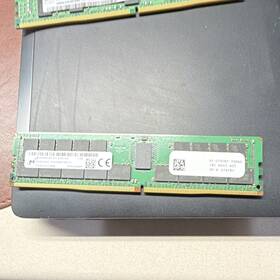
( Brand: Micron ), ( Manufacturer Part Number: MTA18ASF2G72PDZ-2G6J1SI ), ( Form Factor: Dimm ), ( Type: Ddr4 Sdram ), ( Total Capacity: 32 Gb ), ( Number Of Pins: 288 ), ( Bus Speed: Pc4-2666v ), ( Memory Features: Ecc Memory, Registered )
Review MICRON
The **Micron Technology MTA18ASF2G72PDZ-2G6J1SI (32GB) and MTA36ASF4G72PZ-2G6D1QG (32GB)** are high-performance, low-latency DDR4 memory kits designed for demanding computing environments, including workstations, servers, and high-end gaming systems. These modules are part of Micron s **Micron Technology Advanced Server Family (MTA)**, engineered to deliver exceptional reliability, efficiency, and scalability for mission-critical applications. The **MTA18ASF2G72PDZ-2G6J1SI** is a **2x16GB (32GB) dual-rank, registered (RDIMM) kit** operating at **PC4-2666 (DDR4-2666)** with a **CL19-19-19-48** timing profile, optimized for **Intel Xeon Scalable and AMD EPYC** platforms. Its **registered architecture** ensures stable performance in multi-socket configurations, reducing latency and improving data integrity in high-throughput workloads. The **MTA36ASF4G72PZ-2G6D1QG**, on the other hand, is a **4x8GB (32GB) dual-rank, unbuffered (UDIMM) kit** also running at **DDR4-2666 with CL19-19-19-48**, tailored for single-socket systems where lower power consumption and simplified installation are priorities. Both kits feature **Micron s advanced error correction (ECC) technology**, providing robust protection against data corruption, making them ideal for enterprise storage, virtualization, and high-performance computing (HPC) environments. The **V-RB2 (Registered) and V-RB (Unbuffered) variants** ensure compatibility with a wide range of server motherboards, while the **2G6J1SI and 2G6D1QG** designations indicate their optimized performance for **Intel Xeon D-1500/1600 series** and **AMD EPYC 7002/7003** processors, respectively. With **low-power consumption, high endurance, and Micron s proven reliability**, these memory kits are engineered to meet the rigorous demands of modern data centers, ensuring sustained performance under heavy workloads while maintaining energy efficiency. Whether deployed in a multi-node cluster or a high-end workstation, these modules deliver the speed, stability, and scalability required for next-generation computing.
### **Pros and Cons of Buying Micron MTA18ASF2G72PDZ-2G6J1SI (32GB) and MTA36ASF4G72PZ-2G6D1QG (32GB) DDR4-2666 RDIMM Memory Kits**
#### **Overview**
These are **Micron DDR4-2666 RDIMM (Registered DIMM) memory modules**, designed for **enterprise, server, and high-end workstation use**. The **MTA18ASF2G72PDZ-2G6J1SI** is a **32GB (2x16GB) dual-rank module**, while the **MTA36ASF4G72PZ-2G6D1QG** is a **32GB (4x8GB) quad-rank module**. Both support **ECC (Error-Correcting Code)** and are **registered (buffered)**, making them suitable for systems requiring **high reliability and memory channel stability**.
---
### **Pros**
#### **1. High Capacity and Scalability**
- Both kits provide **32GB per DIMM slot**, allowing for **large memory configurations** in servers and workstations.
- The **quad-rank (MTA36ASF4G72PZ) module** offers **better bandwidth per slot** compared to dual-rank, useful in **memory-intensive workloads** (e.g., databases, virtualization, AI/ML).
- Supports **multi-socket servers**, enabling **terabyte-scale memory configurations** when paired with compatible motherboards.
#### **2. Enterprise-Grade Reliability**
- **ECC (Error-Correcting Code)** ensures **data integrity**, critical for **servers, databases, and financial systems** where memory errors can cause crashes or corruption.
- **Registered (buffered) design** reduces **memory channel noise and signal integrity issues**, improving stability in **multi-channel systems**.
- **Micron s reputation for durability** in high-end and server-grade memory makes these modules a **trusted choice** for long-term use.
#### **3. Performance Optimized for Servers**
- **DDR4-2666 speed** is **balanced for server workloads**, offering **better latency than DDR4-2400** while avoiding the power draw of higher-speed modules (e.g., DDR4-3200).
- **Low power consumption** compared to higher-speed memory, which is beneficial for **data center efficiency**.
- **Optimized for latency-sensitive applications** (e.g., in-memory databases, virtualization) due to **registered operation**.
#### **4. Compatibility with High-End Systems**
- Designed for **Intel Xeon, AMD EPYC, and other enterprise-grade CPUs**, ensuring **full compatibility** with **workstation and server motherboards**.
- Supports **multi-channel memory architectures**, allowing for **scalable performance** when paired with additional DIMMs.
- **Micron s memory is often pre-tested and validated** for compatibility with major server platforms.
#### **5. Long-Term Availability and Support**
- Micron is a **leading memory manufacturer**, ensuring **long-term availability** and **software/firmware support** for enterprise deployments.
- **Micron s memory is commonly used in pre-built servers**, making upgrades and replacements easier.
---
### **Cons**
#### **1. High Cost Relative to Consumer Memory**
- **RDIMM/ECC memory is significantly more expensive** than **UDIMM (Unbuffered) or non-ECC memory**, making it **cost-prohibitive for consumer PCs**.
- **32GB per slot pricing** is **much higher than retail DDR4-2666 kits**, which are often **cheaper per GB** for consumer use.
#### **2. Limited Consumer PC Compatibility**
- **Not compatible with most consumer motherboards** (e.g., Intel H-series, B-series, or AMD B550/X570 without server-grade chipsets).
- **Requires a server/workstation motherboard** (e.g., Intel C621, AMD SP3, or Xeon-compatible platforms), which further increases cost.
- **No support for consumer-grade CPUs** (e.g., Intel Core i9, AMD Ryzen Threadripper in non-server configurations).
#### **3. Overkill for Most Consumer Use Cases**
- **ECC and registered memory are unnecessary** for **gaming, content creation (video editing, 3D rendering), or general productivity** unless running **multi-GPU setups or extreme workloads**.
- **DDR4-2666 is slower than DDR4-3200/3600/4000**, which are more common in **high-end consumer builds** for better single-core performance.
#### **4. Higher Latency Compared to LRDIMM or HBM**
- **RDIMM has higher latency than Low-Power RDIMM (LRDIMM) or HBM (High Bandwidth Memory)**, which are used in **ultra-high-performance servers**.
- **Not ideal for extreme AI/ML or HPC workloads** where **LRDIMM or HBM** would be preferred.
#### **5. Requires Proper Cooling and Power Delivery**
- **High-capacity memory configurations** (e.g., **8 DIMMs per channel**) can **increase power draw**, requiring **robust cooling and power supplies**.
- **Server-grade PSUs** are needed to handle **higher memory channel currents**, adding to system cost.
---
### **Conclusion**
These **Micron DDR4-2666 RDIMM modules** are **excellent choices for enterprise, server, and high-end workstation environments** where **reliability, scalability, and ECC protection** are critical. They excel in **database servers, virtualization, and memory-intensive applications** but are **overkill and impractical for most consumer PCs**.
If you are **building a server, a high-end workstation for professional workloads, or a multi-socket system**, these modules provide **superior performance and stability**. However, for **gaming, content creation, or general computing**, they are **unnecessarily expensive and incompatible** with standard consumer hardware.
---
### **Recommendation**
#### **Buy These Modules If:**You are **building a server** (e.g., **Intel Xeon, AMD EPYC, or similar enterprise platform**).
You need **ECC memory for data integrity** (e.g., **databases, virtualization, financial systems**).
You require **large memory configurations (128GB )** for **memory-bound workloads**.
You are **upgrading a pre-existing server** that already uses Micron RDIMM memory.
#### **Avoid These Modules If:**You are **building a consumer PC** (gaming, content creation, office work).
You **don t need ECC** and want **cheaper, faster (DDR4-3200 ) non-ECC memory**.
Your motherboard **does not support RDIMM** (check for **server/workstation chipsets**).
You are **on a tight budget**, as **UDIMM or non-ECC memory** will be **far more cost-effective** for consumer use.
#### **Alternatives to Consider:** - **For Servers/Workstations:**- **Micron DDR4-3200 RDIMM** (if your platform supports it for better performance).
- **Samsung or SK Hynix RDIMM** (often competitive pricing).
- **LRDIMM (Low-Power RDIMM)** if power efficiency is a concern.
- **For Consumer PCs (If ECC is Needed):**- **Corsair Vengeance LPX ECC** (UDIMM, cheaper than RDIMM).
- **G.Skill Trident Z Royal ECC** (better performance than RDIMM in consumer builds).
- **For High-End Workstations (Non-Server):**- **DDR4-3600/4000 UDIMM (non-ECC)** for better single-core performance.
- **AMD Threadripper Pro (WRX90/WRX90S) with compatible memory** if using AMD.
---
### **Final Verdict**
These **Micron DDR4-2666 RDIMM modules** are **best suited for enterprise and server environments** where **reliability, scalability, and ECC are mandatory**. For **consumer or workstation use**, they are **not cost-effective or practical** unless you have a **server-grade system**. If you confirm that your build **requires RDIMM/ECC**, these modules are a **solid, high-quality choice** from a trusted manufacturer. Otherwise, **opt for UDIMM or non-ECC memory** for better performance-to-cost ratios.
Details:
1 Available.
part #: mta18asf2g72pdz-2g6j1si prices
- $200.00-$2357.99
specifications servermemor:
- brand: Micron
- mpn: Mta18asf2g72pdz-2g6j1si
- form factor: Dimm
- type: Ddr4 Sdram
- total capacity: 32 Gb
- number of pins: 288
- bus speed: Pc4-2666v
- memory features: Ecc Memory, Registered
general servermemor:
- Enterprise Networking, Servers > Server Components > Server Memory RAM
- condition: Used
payments servermemor:
- wallet: Google-pay
- other
- credit card: Discover
seller servermemor:
- # reviews: 1
- city: Kent, Washington
- rating: 0.0%
returns servermemor:
- policy: No Returns
offer servermemor:
- availability: In Stock
- options: Ship-to-home
- quantity: 1
- sold: 0
- started: March 1, 2026
- best offers: True
shipping servermemor:
- carrier: USPS
- class: Standard
- type: Calculated
- service: USPS Ground Advantage
- transit: 5-11 Days
- cost: $5.45