MICRON MTA36ASF4G72PXZ-2G3B1II Ecc PC-2400T-RB1-11 32GB DDR4 32GN 2RX4
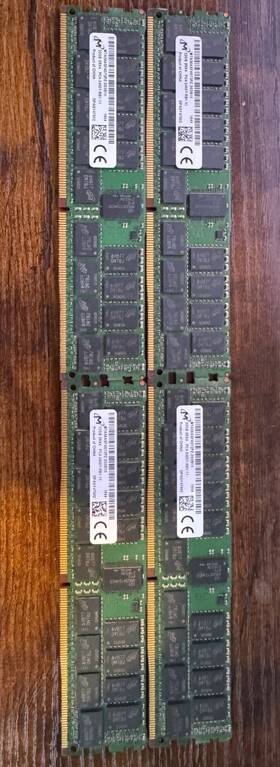
( Brand: Micron ), ( Manufacturer Part Number: MTA36ASF4G72PXZ-2G3B1II ), ( Model: MICRON PC-2400T-RB1-11 MTA36ASF4G72PXZ-2G3B1II ), ( Form Factor: Rdimm ), ( Type: Ecc Ram ), ( Total Capacity: 128 Gb ), ( Unit Type: Unit ), ( Capacity Per Module: 32 Gb ), ( Manufacturer Warranty: Lifetime ), ( Number Of Pins: 288 ), ( Bus Speed: Pc4-19200 ), ( Memory Features: Ecc Memory, Registered )
Review MICRON Lot Of Ecc Ddr4 2rx4
The **Micron MTA36ASF4G72PXZ-2G3B1II** is a high-performance, enterprise-grade **32GB (2x16GB) DDR4 Registered DIMM (RDIMM)** memory module designed for demanding server and workstation applications. Engineered with Micron s precision manufacturing, this module delivers exceptional reliability, scalability, and efficiency, making it an ideal choice for data centers, cloud infrastructure, and high-performance computing environments. Built with **low-power, high-bandwidth DDR4 technology**, it operates at **2400MHz (PC2400T)**, ensuring rapid data transfer rates while maintaining energy efficiency critical for sustained workload performance in mission-critical systems. The **ECC (Error-Correcting Code) functionality** provides robust protection against data corruption, minimizing downtime and ensuring data integrity in fault-tolerant environments. With a **2-rank x 4 (2Rx4) configuration**, this module maximizes memory bandwidth, enabling seamless multitasking and high-throughput operations for applications like virtualization, database management, and AI/ML workloads. The **Registered (Buffered) design** further enhances stability and reduces signal interference on high-channel-count server motherboards, making it compatible with a wide range of enterprise-grade platforms. Micron s **RDIMM modules** are built to meet strict industry standards, including **JEDEC compliance**, ensuring seamless integration with leading server manufacturers. Whether deployed in a single-socket or multi-socket configuration, this memory module optimizes system performance while adhering to stringent reliability benchmarks, making it a trusted component for businesses prioritizing speed, security, and scalability.
**Pros and Cons of Buying Micron MTA36ASF4G72PXZ-2G3B1II (32GB ECC DDR4 32GB 2Rx4 PC-2400T-RB1-11)**
### **Pros:**1. **High Reliability** ECC (Error-Correcting Code) memory is designed for data integrity, making it ideal for servers, workstations, and applications where stability is critical (e.g., databases, virtualization, scientific computing). It automatically corrects single-bit errors and detects multi-bit errors, reducing crashes and data corruption risks.
2. **Low Latency (TCL 11)** The "T" in PC-2400T-RB1-11 indicates a tighter timing (11-11-11-28 at 1.2V), which can improve performance in latency-sensitive workloads compared to standard DDR4 modules with looser timings. This is particularly useful for CPU-bound tasks where faster memory access matters.
3. **Low Power Consumption** The module operates at 1.2V, which is more efficient than higher-voltage DDR4 kits, reducing heat generation and power draw. This is beneficial for systems with limited cooling or high-density configurations.
4. **Registered (Buffered) Design** The "RB1" designation means this is a registered (buffered) DIMM, which helps stabilize memory channels in multi-socket servers by reducing signal noise and improving scalability. This is a requirement for most enterprise-grade servers.
5. **Compatibility with High-End Platforms** This is a server-grade memory module, meaning it is designed to work reliably in professional environments. It is likely compatible with Intel Xeon, AMD EPYC, and other high-end server CPUs, as well as workstations with ECC support (e.g., some Intel Core i7/i9 and AMD Ryzen Threadripper systems).
6. **Long-Term Availability** Micron is a reputable manufacturer with a strong presence in both consumer and enterprise markets. This module is likely to remain available for an extended period, which is useful for long-term projects or replacements.
7. **Cost-Effective for ECC Needs** While ECC memory is generally more expensive than non-ECC, this module offers a balance between performance and reliability. For applications where data integrity is non-negotiable (e.g., financial systems, medical imaging, or HPC), the cost is justified.
---
### **Cons:**1. **Higher Cost Compared to Non-ECC DDR4** ECC memory is significantly more expensive than standard DDR4, especially for high-capacity modules. If your use case doesn t require ECC (e.g., gaming, general desktop use, or non-critical applications), you could save money with non-ECC kits.
2. **Limited Overclocking Potential** Registered DIMMs are not typically overclockable, and the tight timings (11-11-11-28) are already optimized for stability rather than performance gains. If you re looking to push memory speeds beyond the stock settings, this module won t offer that flexibility.
3. **Not Ideal for Consumer-Grade Systems** This is a server/workstation-grade module. Many consumer motherboards (especially budget or mid-range ones) may not support ECC or registered DIMMs. Always check your motherboard s manual to confirm compatibility. Some high-end consumer motherboards (e.g., ASUS ROG Maximus, MSI MEG) do support ECC, but this is not universal.
4. **Lower Capacity Options May Be Cheaper** If you don t need 32GB, purchasing smaller ECC modules (e.g., 16GB or 8GB) and populating them in pairs (for dual-channel) could be more cost-effective for smaller systems. However, this module is already a large capacity, which may be overkill for some use cases.
5. **Potential for Overkill in Non-Server Use** For applications like gaming, content creation (e.g., video editing with non-linear editing software), or general productivity, ECC memory may not provide noticeable benefits. In these cases, non-ECC DDR4 with faster speeds (e.g., DDR4-3200 or DDR4-3600) could offer better performance per dollar.
6. **Voltage Sensitivity** The 1.2V operation means this module is optimized for low power but may not be as forgiving as higher-voltage modules in systems with poor power delivery or unstable PSUs. However, this is more of a concern in extreme overclocking scenarios, which are unlikely with registered DIMMs.
7. **Mixed Use with Non-ECC Modules** Mixing ECC and non-ECC modules in the same channel can cause instability or errors. If you re building a system with a mix of memory types, ensure all modules are ECC-compatible.
---
### **Conclusion:**The **Micron MTA36ASF4G72PXZ-2G3B1II** is an excellent choice if you require **reliable, low-latency ECC memory for server, workstation, or high-integrity workloads**. Its registered design, tight timings, and low power consumption make it well-suited for environments where data integrity and stability are paramount. However, it is **not necessary** for consumer-grade systems, gaming, or non-critical applications where non-ECC memory would suffice at a lower cost.
If your use case involves:- **Servers (virtualization, databases, web hosting)**
- **Workstations (3D rendering, scientific computing, CAD)**
- **Applications requiring error correction (financial systems, medical imaging, HPC)**
Then this module is a strong, reliable option.
If your use case is:- **Gaming, general desktop use, or content creation without ECC requirements**
- **Building a system on a budget where ECC isn t critical**
Then you may find better value in non-ECC DDR4 modules with higher speeds or larger capacities for your specific needs.
---
### **Recommendation:** - **Buy this module if:**- You are building a **server, workstation, or high-end professional system** that requires ECC support.
- Your motherboard supports **registered DIMMs** and ECC memory.
- You prioritize **data integrity, stability, and low-latency performance** over raw speed.
- You need **long-term reliability** and are okay with the higher cost.
- **Avoid this module if:**- You are building a **consumer-grade PC** (gaming, general use) where ECC is unnecessary.
- Your motherboard **does not support ECC or registered DIMMs**.
- You want to **overclock memory** or need higher speeds (e.g., DDR4-3600 or DDR4-4000).
- You are on a **tight budget** and can achieve similar performance with non-ECC memory.
For most **consumer or gaming builds**, look for **non-ECC DDR4 modules with higher speeds (e.g., DDR4-3600 or DDR4-4000)** from brands like Corsair, G.Skill, or Kingston. For **enterprise or workstation builds**, this Micron module is a solid, high-quality choice. Always verify compatibility with your motherboard and CPU before purchasing.
Details:
This was pulled from a functioning system. No problems no errors. Retired server.
specifications servermemor:
- brand: Micron
- mpn: Mta36asf4g72pxz-2g3b1ii
- model: Micron Pc-2400t-rb1-11 Mta36asf4g72pxz-2g3b1ii
- form factor: Rdimm
- type: Ecc Ram
- total capacity: 128 Gb
- unit type: Unit
- capacity per module: 32 Gb
- manufacturer warranty: Lifetime
- number of pins: 288
- bus speed: Pc4-19200
- memory features: Ecc Memory, Registered
general servermemor:
- Enterprise Networking, Servers > Server Components > Server Memory RAM
- condition: Used
seller servermemor:
- rating: 100.0%
- city: Guthrie, Oklahoma
- # reviews: 18
shipping servermemor:
- cost: $7.95
- transit: 5-11 Days
- class: Standard
- type: Calculated
- carrier: USPS
- service: USPS Ground Advantage
returns servermemor:
- policy: No Returns
payments servermemor:
- credit card: Discover
- other
- wallet: Apple-pay
offer servermemor:
- quantity: 1
- options: Ship-to-home
- sold: 0
- best offers: True
- availability: In Stock
- started: April 3, 2026
Micron PC-2400T-RB1-11 Is Similar To:
- 0 11110 23158 1 Ecc Micron (11.4% similar) The picture is a stock photo. Listing summary: 1 lot of 8GB 4x 2GB Micron memory. Note: the item specifics detailed info are not always correct. Sold as used and in working condition. Please with questions before buying. 5 condition: used, tested good...(July 2nd, 2018)
- 0.10525904897770721 0.7934639433487312 Lot 5x Micron (9.2% similar) I'll get back to you as soon I can. Condition: used, working if a power adapter is required for this item, it not included cord shows signs of normal use w some scuffs scratches blemishes sticker residue no other accessories hardware software...(December 22nd, 2017)
- 0.20224299680992108 Lot Micron Ecc Server Ram Hp (22% similar) I'll get back to you as soon I can. Condition: used, working if a power adapter is required for this item, it not included cord shows signs of normal use w some scuffs scratches blemishes sticker residue no other accessories hardware software...(June 8th, 2018)
- 0.22801170583421193 0.298927155894682 Lot 16x Micron (9.2% similar) Condition: used, working, pictured only one but total 16 rams same. I'll get back to you as soon I can. If a power adapter is required for this item, it not included cord shows signs of normal use w some scuffs scratches blemishes sticker residue no other accessories hardware software...(December 22nd, 2017)
- 0.26622135794166435 Lot Micron Ecc Server Ram Memory Dell (22.1% similar) Condition: used, working if a power adapter is required for this item, it not included cord shows signs of normal use w some scuffs scratches blemishes sticker residue no other accessories hardware software. I'll get back to you as soon I can...(June 11th, 2018)
- 0.3483837301561905 Micron Ecc Server Ram Hp (23% similar) I'll get back to you as soon I can. Condition: used, working if a power adapter is required for this item, it not included cord shows signs of normal use w some scuffs scratches blemishes sticker residue no other accessories hardware software...(July 17th, 2018)
- 0.36513694130424335 Lot Micron Server Vlp Ram Ibm (17.2% similar) Condition: used, working if a power adapter is required for this item, it not included cord shows signs of normal use w some scuffs scratches blemishes sticker residue no other accessories hardware software. I'll get back to you as soon I can...(October 19th, 2018)
- 0.6842008029848028 Lot Micron Server Ecc Memory Hp (21.7% similar) Condition: used, working if a power adapter is required for this item, it not included cord shows signs of normal use w some scuffs scratches blemishes sticker residue no other accessories hardware software. I'll get back to you as soon I can...(June 18th, 2018)
- 0.6896737264585662 Lot Micron Ecc Server Ram Ibm (23.6% similar) I'll get back to you as soon I can. Condition: used, working if a power adapter is required for this item, it not included cord shows signs of normal use w some scuffs scratches blemishes sticker residue no other accessories hardware software...(June 29th, 2018)
- 0.6910968341728292 Lot Micron Ecc Ram (19% similar) Condition: used, working if a power adapter is required for this item, it not included cord shows signs of normal use w some scuffs scratches blemishes sticker residue no other accessories hardware software. I'll get back to you as soon I can...(April 4th, 2018)
- 0.7963132840829785 Lot Micron Mhz Ecc Reg Ram Hp (26.8% similar) Condition: used, working if a power adapter is required for this item, it not included cord shows signs of normal use w some scuffs scratches blemishes sticker residue no other accessories hardware software. I'll get back to you as soon I can...(May 16th, 2018)