HPE P03049-191 Ecc Rdimm Server Ram 2X 8GB PC4-2933Y DDR4 1RX8 DL380 DL360
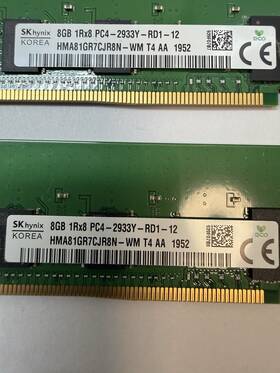
( Brand: Hpe ), ( Manufacturer Part Number: P03049-191 ), ( Total Capacity: 8 Gb ), ( Memory Features: Ecc Memory ), ( California Prop 65 Warning: No ), ( Form Factor: Dimm ), ( Type: Ddr4 Sdram ), ( Unit Type: Unit ), ( Manufacturer Warranty: Lifetime ), ( Number Of Pins: 288 ), ( Bus Speed: Pc4-23400 ), ( Country Of Origin: United States )
Review HPE 2x 8gb Ddr4 Ecc Rdimm Server Ram
The **HPE P03049-191 2x8GB PC4-2933Y DDR4 ECC RDIMM 1Rx8 Server Memory** is a high-performance, enterprise-grade memory module meticulously engineered for mission-critical workloads in HPE ProLiant DL380 and DL360 Gen10 and Gen11 server platforms. Designed to deliver uncompromising reliability and scalability, this **2-rank (1Rx8) Registered Dual In-Line Memory Module (RDIMM)** configuration provides a robust foundation for data-intensive applications, virtualization environments, and high-throughput computing scenarios. With a **capacity of 16GB per DIMM**, this memory module leverages **DDR4 technology at a clock speed of 2933MHz**, ensuring optimal data throughput and reduced latency for seamless performance in demanding server operations. The **ECC (Error-Correcting Code) functionality** embedded within the module actively detects and corrects single-bit errors, safeguarding critical data integrity and minimizing downtime in fault-tolerant systems. The **PC4-2933Y designation** further underscores its compatibility with HPE s advanced memory controllers, enabling efficient memory channel utilization and supporting configurations up to **128GB per socket** in compatible server models. Built to HPE s stringent quality standards, this RDIMM module features **low-power, high-density components** that enhance operational efficiency while maintaining thermal stability. Whether deployed in a **DL380 Gen10** for enterprise storage solutions or a **DL360 Gen11** for high-density compute clusters, this memory module ensures consistent performance, scalability, and long-term reliability making it an indispensable component for businesses demanding peak server performance in demanding IT infrastructures.
### **Pros and Cons of Buying P03049-191 (2x 8GB PC4-2933Y DDR4 ECC RDIMM 1Rx8 for HPE DL380/DL360)**
#### **Pros:**1. **Compatibility with HPE DL380/DL360 Gen10/Gen11 Servers**
- This is a **registered DIMM (RDIMM)** designed specifically for HPE s mid-range server platforms, ensuring proper recognition and stability. It supports **Dual Rank (2Rx8)** configurations, which are common in these systems.
2. **High Performance (PC4-2933Y)**
- **2933 MHz** speed is optimal for modern workloads, offering better throughput than slower DDR4 modules (e.g., 2666 MHz). The "Y" suffix indicates it is **low-power** (1.2V), which helps with thermal efficiency in dense server configurations.
3. **Error-Correcting Code (ECC) Support**
- ECC RAM is critical for **data integrity** in servers, preventing silent data corruption in critical applications (databases, virtualization, financial systems). This is a must for enterprise environments.
4. **Registered DIMM (RDIMM) Design**
- RDIMMs are **buffered**, reducing the load on the memory controller and improving stability in multi-socket servers. They are also **more power-efficient** than LRDIMMs in single-socket configurations.
5. **Reliability & Warranty**
- HPE (or authorized sellers) typically provides **extended warranties** (often 3 5 years) and **spare parts support**, which is valuable for mission-critical infrastructure.
6. **Scalability**
- These modules can be **mixed with other RDIMMs** (e.g., 16GB, 32GB) in compatible slots, allowing gradual upgrades without full replacement.
7. **Low Latency (1Rx8 Configuration)**
- A **single-rank (1Rx8)** design reduces latency compared to dual-rank (2Rx8) modules, which can be beneficial for certain workloads (e.g., real-time processing).
---
#### **Cons:**1. **Limited Capacity (8GB per Module)**
- At **16GB total (2x8GB)**, this is **low-end** for modern server workloads. Many applications (e.g., large databases, high-end virtualization) require **32GB per socket** for optimal performance. You may need to **upgrade later**, increasing long-term costs.
2. **Higher Cost per GB Compared to LRDIMMs**
- RDIMMs are **more expensive per GB** than **Load-Reduced DIMMs (LRDIMMs)** or **Unbuffered DIMMs (UDIMMs)**. If your server supports LRDIMMs (e.g., DL380 Gen10 ), they may offer better cost efficiency for larger configurations.
3. **Potential for Overkill in Small Workloads**
- If you only need **basic file serving, lightweight virtualization, or small databases**, this RAM may be **more than necessary**, leading to **higher upfront costs** without significant performance gains.
4. **Vendor Lock-In with HPE**
- HPE s proprietary memory can be **less flexible** than third-party alternatives (e.g., Crucial, Kingston). If you ever switch to a non-HPE server, these modules **won t be usable**, increasing future replacement costs.
5. **No Support for Future CPU Generations**
- Newer Intel Xeon or AMD EPYC CPUs may require **higher memory speeds (e.g., DDR4-3200 )** or **new memory types (e.g., DDR5)**. This module is **limited to 2933 MHz DDR4**, which may become outdated.
6. **Mixed-Memory Risks**
- If you later add **different-speed or different-rank modules**, you may encounter **performance bottlenecks** or **compatibility issues** in some server configurations.
7. **No NVDIMM Support (If Needed for Persistent Memory)**
- If your workload requires **non-volatile DIMMs (NVDIMMs)** for caching or persistence, these standard RDIMMs **won t support that feature**.
---
### **Conclusion & Recommendation**
#### **Best For:**- **Small to medium enterprise workloads** (e.g., file servers, basic virtualization, lightweight databases) where **16GB per socket is sufficient**.
- **HPE DL380/DL360 Gen10/Gen11 users** who need **ECC, RDIMM compatibility, and 2933 MHz speed** without overpaying for higher capacities.
- **Budget-conscious buyers** who prioritize **HPE support and reliability** over maximum performance.
#### **Not Ideal For:**- **High-performance computing (HPC), large-scale virtualization, or database-heavy workloads** (where **32GB per socket is recommended**).
- **Future-proofing** if you plan to upgrade CPUs or memory in 3 5 years, consider **higher-capacity (32GB) or higher-speed (3200 MHz) modules**.
- **Non-HPE environments** if you might switch to other server brands, **third-party RDIMMs or LRDIMMs** may be more flexible.
#### **Recommendation:**- **If your workload requires only 16GB per socket and you need HPE-certified RDIMMs, this is a solid choice.**
- **For better long-term value, consider:**- **P03049-192 (2x 16GB PC4-2933Y RDIMM)** if you can afford the upgrade.
- **HPE 945352-B21 (2x 32GB PC4-2933Y RDIMM)** if you anticipate future growth.
- **LRDIMMs (if your server supports them)** for better cost efficiency in larger configurations.
- **If you re unsure about future needs, buy slightly more RAM now (e.g., 32GB modules) to avoid costly upgrades later.**
#### **Final Verdict:**This **2x 8GB PC4-2933Y RDIMM** is a **good entry-level choice for HPE DL380/DL360 servers** where **16GB per socket is adequate**. However, if you expect **higher memory demands**, investing in **higher-capacity modules now** will save money and reduce future complexity. Always **check your server s memory configuration guide** to ensure compatibility with other modules.
Details:
Listing is for HPE Compatible 8GB DDR4-2933MHz ECC Registered Dims, pulled from a working, lightly-used non-data center environment. Both sticks are in good condition and tested functional. Type: DDR4 ECC Registered RDIMM. Condition: Used Good.
Part Number: P03049-191. Always verify against your servers Quick Specs or HPE Memory Configured before purchasing. Specifications: Capacity: 8GB per stick. Pulled from a working system in lightly-used, non-data center environment.
Far less wear than typical enterprise pulls. Questions about compatibility.
part #: p03049191 prices
- $160.00-$315.00
specifications servermemor:
- brand: Hpe
- mpn: P03049-191
- total capacity: 8 Gb
- memory features: Ecc Memory
- california prop 65 warning: No
- form factor: Dimm
- type: Ddr4 Sdram
- unit type: Unit
- manufacturer warranty: Lifetime
- number of pins: 288
- bus speed: Pc4-23400
- country of origin: United States
general servermemor:
- Enterprise Networking, Servers > Server Components > Server Memory RAM
- condition: Used
seller servermemor:
- rating: 100.0%
- # reviews: 620
- city: Belfair, Washington
offer servermemor:
- options: Ship-to-home
- best offers: True
- sold: 0
- availability: In Stock
- started: February 26, 2026
- quantity: 2
payments servermemor:
- wallet: Apple-pay
- other
- credit card: Visa
returns servermemor:
- policy: No Returns
shipping servermemor:
- carrier: USPS
- service: USPS Ground Advantage
- transit: 5-11 Days
- type: Calculated
- class: Standard
- cost: $5.20
Hpe P03049-191 Is Similar To:
- 202172-b21-rf Hpe Ims Cpo Kit Ddr Ecc 0720591479978 (27.2% similar) Orders usually ship the same day are placed or following...(August 28th, 2018)
- 647903b21 Hpe Server Options 32gb 886111439485 (25% similar) Let us create a positive community together. height inch. Dram quality and reliability are more important now than ever. 32GB kit 1X32GB qr x4 DDR3 product description is finding reliable dram memory for your hp pliant server series in data a major challenge when you choose smart memory get the ...(January 17th, 2018)
- 850880-001 Hpe Ecc Registered Single Rank (27.8% similar) Hpe 16GB 2666MHZ DDR4 ecc 288PIN 1RX4 PC4-2666V-R memory...(October 18th, 2018)
- 862690-091 Hpe Ecc Unbuffered Memory (27.3% similar) ...(July 23rd, 2018)
- 862974-b21-mb Mb Ecc Udimm Hpe Ml Gl (34.5% similar) Suppertime content version else if navigator. Write '' document. User agent navigator. Write ' n' document. Please bid accordingly. Index of win. Index of Muse navigator...(February 4th, 2019)
- 879507-b21 Hpe Iss Bto New Sdram Memory Module Ram 190017199764 (26.3% similar) Unlike third-party alternatives, Hpe standard memory is sourced from the highest-quality drams and undergoes a rigorous testing authentication process. Hpe standard memory options are designed to deliver performance, reliability and efficiency at an affordable price. With Hpe DDR4 standard memory, ...(January 1st, 2019)
- A8087bx Hpe Hp Dimm Ecc (20.6% similar) High quality 100 original fast shipping...(September 18th, 2018)
- Ebj81rf4bdwd-gn-f Elpida Ecc Reg Ram Hpe (26.3% similar) Eloped 8GB PC4-2400T ecc registered ram Hpe 071PART number EBJ81RF4BDWD-GN-FFOR use in a server, not to be used desktop. Items must be received in the same condition as pictured original offer. When sending the message, on topics, please choose details or other...(October 23rd, 2018)
- Hma42gr7bjr4n-uh Hynix Hpe Ecc Reg Ram (25% similar) Items must be received in the same condition as pictured original offer. UNIX 16GB PC4-2400T ecc registered ram Hpe 001PART number HMA42GR7BJR4N-UHFOR use in a server, not to be used desktop. When sending the message, on topics, please choose details or other...(October 23rd, 2018)
- Pc4-2133p-r 803028-b21 Hp Hpe 8gb Registered Ecc 1rx4 Memory Module Pc4-17000 (30.5% similar) 20V free ground shipping for continental us. It creations. Buyer pays shipping and handling. Shipping shipping shipping costs listed are to the 48 contiguous states. Or its subsidiaries in the USA and other countries...(November 23rd, 2016)
- 647903-b21 Hpe Server Options New 32gb Kit 1x32gb Qr X4 0886111439485 (21% similar) Personal care items if the item is defective the customer will need to contact the manufacturer directly. Merchandise must be in original factory condition, and must include all original packaging materials, warranty cards, manuals and accessories. Gaming includes brand new consoles and games for ...(June 29th, 2016)