SAMSUNG PC4-3200AA-RD1-12-DC1 Server Ram 8GB 1RX8
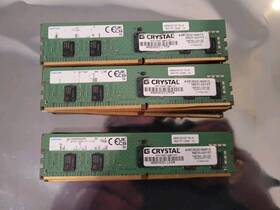
( Brand: Samsung ), ( Manufacturer Part Number: PC4-3200AA-RD1-12-DC1 ), ( Form Factor: Dimm ), ( Type: Ddr4 Sdram ), ( Unit Type: Unit ), ( Capacity Per Module: 8 Gb ), ( Bus Speed: Pc4-3200aa ), ( Memory Features: Ecc Memory, Registered )
Review SAMSUNG 8gb Server Ram
The **Samsung PC4-3200A-RD1-12-DC1 14 8GB 1Rx8 Server RAM** module is a high-performance, enterprise-grade memory solution engineered to deliver exceptional reliability, speed, and efficiency in demanding server environments. Part of Samsung s **RDIMM (Registered DIMM)** lineup, this memory module is designed specifically for data centers and mission-critical applications where low-latency, high-bandwidth performance, and robust error correction are essential. With a **14-nanometer process technology**, this RAM module ensures optimal power efficiency while maintaining peak performance, making it an ideal choice for modern x86-based servers that support DDR4 architecture.
Featuring a **single-rank (1Rx8) configuration**, this module provides a balanced approach between capacity and bandwidth, allowing for smooth multitasking and high-throughput operations without the overhead of multi-rank latency. The **8GB capacity** per module ensures scalability, enabling administrators to build systems with up to 24GB per DIMM slot (when paired with additional modules) while adhering to industry-standard form factors. The **PC4-3200** designation indicates a **2133MHz (DDR4-2133)** speed rating, delivering sustained data transfer rates of **17.07 GB/s per channel**, which is critical for accelerating workloads such as virtualization, database management, and high-performance computing (HPC).
One of the standout features of this RAM is its **RDIMM architecture**, which incorporates a **registered buffer chip** to manage data signals more efficiently, reducing signal integrity issues and improving stability in large memory configurations. This design is particularly beneficial in servers with multiple DIMMs, where unregistered (UDIMM) modules might experience performance bottlenecks or increased error rates. Additionally, the **ECC (Error-Correcting Code)** functionality built into the module ensures data integrity by automatically detecting and correcting single-bit errors, minimizing the risk of system crashes or data corruption an indispensable feature for environments handling sensitive or mission-critical information.
The **DC1 (Data Center 1.0) specification** signifies that this module adheres to strict industry standards for reliability, thermal management, and power efficiency, making it suitable for 24/7 operation in high-density server racks. Samsung s rigorous quality control processes, including advanced testing for endurance and thermal stability, ensure that this RAM maintains peak performance even under prolonged heavy loads. The module s **low-profile design** and **standard 288-pin DDR4 interface** guarantee seamless compatibility with a wide range of server platforms, including those from Dell, HP, Lenovo, and other major vendors that support DDR4 RDIMMs.
For administrators prioritizing **cost-effectiveness and long-term value**, this module offers an excellent balance between performance and affordability. Its **low power consumption** (relative to higher-speed alternatives) helps reduce operational costs while still delivering the speed and capacity needed for modern workloads. Whether deployed in a **virtualized data center, cloud infrastructure, or high-performance computing cluster**, this Samsung RDIMM module provides the foundation for a robust, high-performing server environment that can scale with evolving business demands. Built to meet the rigorous demands of enterprise-grade applications, it exemplifies Samsung s commitment to delivering memory solutions that combine cutting-edge technology with uncompromising reliability.
**Pros and Cons of buying a Samsung PC4-3200A-AA-RD1-12-DC1 (14 8GB 1Rx8 Server RAM)**
### **Pros:** 1. **High Performance and Speed:**The RAM operates at **PC4-3200**, which translates to **1600 MHz** (DDR3L) with low power consumption. This speed is suitable for most modern server workloads, including virtualization, database management, and general server operations. The low power draw (DDR3L) helps reduce cooling and energy costs compared to standard DDR3.
2. **Reliability and Quality:**Samsung is a well-known manufacturer with a strong reputation for producing high-quality, durable memory modules. The **RD1** series is designed for server and enterprise environments, offering better stability and longevity than consumer-grade RAM.
3. **Compatibility with Server Hardware:**This is a **registered (RDIMM)** module, which is specifically designed for server motherboards. Registered RAM helps reduce motherboard trace loading, improving stability in multi-socket systems. It is also compatible with **ECC (Error-Correcting Code)** memory, which is essential for data integrity in servers.
4. **Low Latency:**The **CL9** (CAS latency) timing is reasonable for server applications, balancing speed and stability. Lower latency can improve performance in latency-sensitive tasks.
5. **Single-Rank (1Rx8) Configuration:**While single-rank RAM is less common in high-end servers, it can be beneficial in certain configurations where bandwidth is sufficient, and power efficiency is prioritized. It also simplifies installation in systems with limited slots.
6. **Unbuffered (Non-Buffered) Option:**The module is **unbuffered**, meaning it lacks a register buffer, which can reduce latency in some cases. However, this is less common in server RAM, so ensure your server motherboard supports it.
7. **Wider Availability and Cost-Effectiveness:**As a widely used part, this RAM is often available at competitive prices, especially in bulk or refurbished markets. It is a cost-effective choice for upgrading existing server systems.
---
### **Cons:** 1. **Not ECC (Unless Specified Otherwise):**The **PC4-3200A-AA-RD1** is typically **non-ECC** unless explicitly labeled as such. Servers handling critical data (databases, financial systems, etc.) require **ECC RAM** to detect and correct memory errors. If ECC is not included, this could be a significant drawback for mission-critical applications.
*Note: Double-check the exact model number, as some variants may include ECC. Samsung s "AA" series is often non-ECC, while "RDIMM" can sometimes refer to ECC modules in other contexts.*
2. **Single-Rank (1Rx8) Limitations:**Single-rank RAM has **lower bandwidth** compared to dual-rank (2Rx8) or quad-rank (4Rx8) modules. In high-performance server workloads (e.g., heavy virtualization, large-scale databases), multi-rank RAM can provide better throughput. This module may not be ideal for future-proofing or high-end server setups.
3. **Potential Compatibility Issues:**While RDIMMs are server-grade, some older or budget server motherboards may not support **DDR3L** or specific RDIMM configurations. Always verify compatibility with your motherboard s **QVL (Qualified Vendor List)** or documentation.
4. **No Heat Spreaders (Potential Overheating Risk):**Some Samsung server RAM modules lack heat spreaders, which can lead to higher temperatures in high-density server environments. Overheating may reduce lifespan or cause instability.
5. **Limited Upgrade Path:**If you later need to upgrade to **DDR4 or DDR5**, this DDR3 module will not be compatible. DDR3 is nearing end-of-life in many server markets, so this could be a long-term limitation.
6. **Mixed Use with Other RAM:**If your server already has RAM installed, mixing different speeds, ranks, or timings (even from the same manufacturer) can cause instability. Ensure this module matches your existing RAM specifications.
7. **No Error Correction (If Non-ECC):**Without ECC, the risk of **undetected memory errors** increases, which can lead to data corruption in critical systems. This is a major drawback for servers running databases, virtual machines, or financial applications.
---
### **Conclusion:** The **Samsung PC4-3200A-AA-RD1-12-DC1 (14 8GB 1Rx8)** is a **decent choice for basic server workloads** where:- You need **reliable, low-power DDR3L RAM** for non-critical or legacy systems.
- Your server **does not require ECC** (e.g., a file server, lightweight web server, or non-critical VM host).
- You are working with a **compatible server motherboard** that supports RDIMMs and DDR3L.
- You prioritize **cost-effectiveness** over maximum performance.
However, it is **not ideal for:**- **Mission-critical servers** (databases, financial systems, high-availability clusters) where **ECC is mandatory**.
- **High-performance workloads** (heavy virtualization, large-scale computing) where **multi-rank or DDR4/DDR5 would be better**.
- **Future-proofing**, as DDR3 is outdated and may not be supported in newer server hardware.
---
### **Recommendation:** 1. **If ECC is Required:**Replace this with a **Samsung ECC RDIMM module** (e.g., **Samsung M393B1G70QH0-CF8** or similar) to ensure data integrity. ECC RAM is essential for servers handling sensitive or critical data.
2. **If Non-ECC is Acceptable:**This module is fine for **non-critical servers** (e.g., media servers, lightweight web servers, or legacy systems). Ensure your motherboard supports **DDR3L RDIMMs** and that you are not mixing speeds/ranks.
3. **For Better Performance:**Consider **DDR4 or DDR5 ECC RDIMMs** if upgrading to newer hardware. Modern servers benefit from higher speeds (e.g., **DDR4-2400 or DDR5-3200**) and better bandwidth.
4. **Check Compatibility:**Always verify the exact model number and confirm with your motherboard s **QVL** or manufacturer to avoid compatibility issues.
5. **Alternative Options:**- **Crucial/Kingston ECC RDIMMs** (often more affordable).
- **Dell/HPE/IBM-compatible RAM** if your server is from those brands (may have better support).
**Final Verdict:**This RAM is **sufficient for basic server needs** but **not ideal for high-reliability or high-performance environments**. If ECC is not required and compatibility is confirmed, it is a **cost-effective, reliable choice**. Otherwise, prioritize **ECC and multi-rank modules** for better long-term performance.
Details:
part #: pc43200aard112dc1 prices
- $36.00-$59.99
specifications servermemor:
- brand: Samsung
- mpn: Pc4-3200aa-rd1-12-dc1
- form factor: Dimm
- type: Ddr4 Sdram
- unit type: Unit
- capacity per module: 8 Gb
- bus speed: Pc4-3200aa
- memory features: Ecc Memory, Registered
returns servermemor:
- policy: No Returns
seller servermemor:
- # reviews: 349
- city: Duxbury, Massachusetts
- rating: 99.3%
general servermemor:
- Enterprise Networking, Servers > Server Components > Server Memory RAM
- condition: For parts or not working
offer servermemor:
- options: Ship-to-home
- quantity: 1
- sold: 0
- best offers: True
- started: February 18, 2026
- availability: In Stock
payments servermemor:
- credit card: Visa
- wallet: Paypal
- other
shipping servermemor:
- carrier: UPS
- service: UPS Ground
- transit: 3-7 Days
- type: Calculated
- cost: $16.72
- class: Standard
Samsung PC4-3200AA-RD1-12-DC1 Is Similar To:
- 0.09744922496769814 Samsung Ecc Reg Ram (35.2% similar) No other accessories hardware software. I'll get back to you as soon I can...(November 17th, 2018)
- 0.11338225633667265 Lot Samsung Ecc Server Ram Memory (40% similar) Condition: used, working if a power adapter is required for this item, it not included cord shows signs of normal use w some scuffs scratches blemishes sticker residue no other accessories hardware software. I'll get back to you as soon I can...(March 27th, 2018)
- 0.1258726855836516 Lot Samsung Server Vlp Ram Ibm (35.6% similar) I'll get back to you as soon I can. Condition: used, working, pictured one but total 36 same if a power adapter is required for this item, it not included cord shows signs of normal use w some scuffs scratches blemishes sticker residue no other accessories hardware software...(October 19th, 2018)
- 0.3518165772947017 Samsung Cn Ram Ecc Reg Qty (24.7% similar) No other accessories hardware software. I'll get back to you as soon I can...(May 7th, 2018)
- 0.4190561585571104 Lot Samsung Ecc Server Ram (43.3% similar) Condition: used, working if a power adapter is required for this item, it not included cord shows signs of normal use w some scuffs scratches blemishes sticker residue no other accessories hardware software. I'll get back to you as soon I can...(October 13th, 2018)
- 0.4196896457027133 Samsung Ecc Reg Ram (35.6% similar) No other accessories hardware software. I'll get back to you as soon I can...(November 9th, 2018)
- 0.42639317034624824 Samsung Server Vlp Ram Ibm (36.7% similar) I'll get back to you as soon I can. Condition: used, working if a power adapter is required for this item, it not included cord shows signs of normal use w some scuffs scratches blemishes sticker residue no other accessories hardware software...(October 19th, 2018)
- 0.7823584412062607 Samsung Reg Ecc Ram Cn Qty (26.8% similar) I'll get back to you as soon I can. No other accessories hardware software...(June 19th, 2018)
- 0.850481806304197 Lot Samsung Hynix Server Ecc Ram (39.2% similar) Condition: used, working if a power adapter is required for this item, it not included cord shows signs of normal use w some scuffs scratches blemishes sticker residue no other accessories hardware software. I'll get back to you as soon I can...(October 16th, 2018)
- 0.9685219361416628 Lot Samsung Server Vlp Ram (37.1% similar) Condition: used, working, pictured one but total 32 same if a power adapter is required for this item, it not included cord shows signs of normal use w some scuffs scratches blemishes sticker residue no other accessories hardware software. I'll get back to you as soon I can...(October 20th, 2018)
- 0.9709607809767642 Samsung Micron Server Vlp Ram Ibm (40.4% similar) I'll get back to you as soon I can. Condition: used, working if a power adapter is required for this item, it not included cord shows signs of normal use w some scuffs scratches blemishes sticker residue no other accessories hardware software...(October 20th, 2018)