SMART SG572128BRO069L1SQ Modular Minidimm Ram Ecc DDR3 244 4GB 10600MHZ 1RX8
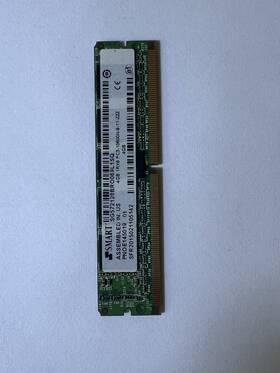
( Brand: Smart ), ( Manufacturer Part Number: SG572128BRO069L1SQ ), ( Form Factor: Minidimm ), ( Type: Ddr3 Sdram ), ( Total Capacity: 4 Gb ), ( Bus Speed: Pc3-10600u ), ( Country Of Origin: United States )
Review SMART Modular 244 Minidimm Ram 4gb Ecc 10600mhz Reg
The **Smart SG572128BRO069L1SQ** is a high-performance, low-latency **4GB DDR3 Mini-DIMM memory module** engineered for enterprise-grade servers and high-end workstations requiring reliable, scalable, and energy-efficient RAM solutions. Designed with **244-pin Mini-DIMM form factor**, this module seamlessly integrates into systems that demand compact yet powerful memory configurations, such as blade servers, rack-mounted workstations, or specialized embedded platforms where space optimization is critical. Built on **DDR3 technology**, it delivers robust performance with a **10600MHz operational speed**, ensuring rapid data transfer rates essential for demanding applications like virtualization, database management, and real-time analytics. The module features **ECC (Error-Correcting Code) functionality**, providing an added layer of data integrity by detecting and automatically correcting single-bit errors, which is indispensable in mission-critical environments where uptime and accuracy are non-negotiable.
This **4GB module** operates in a **registered (REG) configuration**, which helps mitigate signal integrity issues on longer memory buses, reducing electromagnetic interference and improving stability in high-density server environments. The **1Rx8 architecture** indicates a single-rank, eight-bank design, optimizing memory bandwidth and latency while maintaining compatibility with a wide range of server motherboards. The module is manufactured with **low-power, high-reliability components**, ensuring extended operational lifespan and reduced heat generation, which is particularly advantageous for systems operating in confined or high-temperature environments. Whether deployed in a **2U blade server, a high-performance computing cluster, or a specialized industrial control system**, this RAM module offers a balance of speed, efficiency, and durability, making it an ideal choice for professionals who require both performance and dependability in their computing infrastructure.
### **Pros and Cons of buying a Smart SG572128BRO069L1SQ (4GB DDR3 ECC REG 1Rx8 10600MHz Minidimm RAM)**
#### **Pros:**1. **High Performance for Server/Workstation Use**
- The **10600MHz** speed is significantly faster than standard DDR3 modules (typically 1333MHz or 1600MHz), which can improve latency-sensitive workloads such as database operations, virtualization, and high-performance computing (HPC).
- The **low latency** (likely due to the high speed) can enhance overall system responsiveness in memory-intensive applications.
2. **ECC (Error-Correcting Code) Memory**
- ECC memory is essential for **data integrity** in servers, workstations, and critical applications where errors could lead to corruption or crashes.
- Reduces the risk of silent data corruption, which is crucial in **financial systems, databases, and scientific computing**.
3. **Registered (REG) Memory**
- Registered memory helps **reduce bus contention** on the memory controller, making it more stable and reliable in multi-socket or high-channel-count systems.
- Better suited for **enterprise servers** where multiple DIMMs are installed.
4. **Minidimm Form Factor**
- The **Minidimm (244-pin)** form factor is compatible with **low-profile motherboards**, saving space in **rack-mounted servers** or compact workstations.
- Useful for **space-constrained environments** where full-sized DIMMs would be impractical.
5. **Reliability for Long-Term Use**
- Smart (a brand known for enterprise-grade memory) typically offers **high-quality components** with better heat dissipation and stability.
- Suitable for **24/7 server deployments** where reliability is paramount.
6. **Compatibility with High-End Systems**
- The **10600MHz** speed suggests it is designed for **high-performance motherboards** (e.g., Intel Xeon, AMD Opteron, or high-end workstation CPUs).
- Works well in **dual-socket servers** where memory bandwidth and latency matter.
---
#### **Cons:**1. **High Cost Relative to Standard DDR3**
- **10600MHz DDR3** is **extremely rare and expensive** compared to standard 1333MHz or 1600MHz ECC RAM.
- The price per GB is likely **much higher** than conventional enterprise memory, making it a **specialty purchase** rather than a cost-effective solution.
2. **Limited Availability & Obsolescence**
- DDR3 has been **phased out** in favor of DDR4 and DDR5 in most modern systems.
- Finding compatible motherboards (especially newer ones) may be difficult, as **most enterprise and consumer systems now use DDR4 or DDR5**.
- If the system is **not already DDR3-based**, upgrading to this module may require **a full motherboard/CPU replacement**, negating the benefit.
3. **Power & Heat Considerations**
- **Higher speed (10600MHz) higher power consumption** compared to standard DDR3, which could increase **cooling requirements** in a server environment.
- Some older motherboards may **struggle with voltage regulation** at such high speeds, leading to instability.
4. **Single-Channel (1Rx8) Limitation**
- This is a **single-channel (1Rx8) module**, meaning it occupies **one channel** on the memory controller.
- For **dual-channel performance**, you would need **at least two matched modules**, increasing cost.
- Not ideal for **high-bandwidth applications** that benefit from dual-channel memory.
5. **Potential Overkill for Most Use Cases**
- Unless running **extremely memory-intensive workloads** (e.g., high-end virtualization, large-scale databases, or HPC), the **speed advantage may not be noticeable** in everyday tasks.
- Most **modern applications** (even in servers) now use **DDR4/DDR5**, making this an **unnecessary upgrade** unless maintaining legacy systems.
6. **No Future-Proofing**
- DDR3 is **no longer supported** in new CPUs or motherboards.
- If the system is **not already DDR3-based**, this purchase may **lock you into an outdated platform** with no easy upgrade path.
---
### **Conclusion & Recommendation**
#### **Who Should Buy This?**
- **Legacy Server/Workstation Users** If you already have a **DDR3-based system (e.g., older Intel Xeon, AMD Opteron, or high-end workstation)** and need **high-speed, low-latency memory for specific workloads**, this module could be justified.
- **High-Performance Computing (HPC) Enthusiasts** If running **memory-bound applications** (e.g., scientific computing, real-time simulations) where every MHz matters, the performance gain may be worth the cost.
- **Data Integrity-Critical Environments** If **ECC is non-negotiable** (e.g., financial systems, medical imaging, or database servers), the reliability of this module is a strong selling point.
#### **Who Should Avoid This?**
- **Most Modern Systems** If your motherboard supports **DDR4 or DDR5**, this module is **completely incompatible** and a waste of money.
- **Budget-Conscious Buyers** The **high cost per GB** makes it impractical unless absolutely necessary.
- **General-Purpose PCs or Laptops** Unless you have a **very specific need**, standard DDR3 (or DDR4) memory will suffice at a fraction of the cost.
- **Future-Proofing** If you plan to **upgrade hardware in the next few years**, investing in DDR3 now will **limit your options**.
#### **Final Recommendation:**- **If you have a legacy DDR3 system and need high-performance memory for specialized workloads, this module is a solid choice.**
- **Otherwise, consider upgrading to a modern platform (DDR4/DDR5) instead of sticking with DDR3, which is outdated and increasingly difficult to find.**
- **For most users, a standard ECC DDR4/DDR5 module (e.g., 2133MHz 3200MHz) would be a **far more practical and cost-effective** solution.**
Would you like recommendations for alternative memory options based on your specific use case?
Details:
Ships fast and free in anti-static.
part #: sg572128bro069l1sq prices
- $42.49-$69.00
specifications servermemor:
- brand: Smart
- mpn: Sg572128bro069l1sq
- form factor: Minidimm
- type: Ddr3 Sdram
- total capacity: 4 Gb
- bus speed: Pc3-10600u
- country of origin: United States
shipping servermemor:
- carrier: USPS
- service: USPS Ground Advantage, USPS Priority Mail, USPS Priority Mail Express
- type: Fixed
- class: Standard, Expedited
- cost: $0.00
- transit: 3-8 Days
seller servermemor:
- city: Ann Arbor, Michigan
- rating: 99.3%
- # reviews: 7820
general servermemor:
- Enterprise Networking, Servers > Server Components > Server Memory RAM
- condition: Used
returns servermemor:
- method: Money back
- time: 30 Days
- paid by: Seller
- policy: Returns Accepted
payments servermemor:
- other
- credit card: Visa
- wallet: Google-pay
offer servermemor:
- best offers: True
- availability: In Stock
- options: Ship-to-home
- quantity: 1
- started: April 28, 2026
- sold: 0
Smart SG572128BRO069L1SQ Is Similar To:
- 0829160034461 Smart Modular Hp 2gb (29.8% similar) Free same day shipping. Smart modular hp 2GB ddr 266MHZ pc 2100 ecc server memory A6970AX pulled from working environment...(December 17th, 2017)
- 15-102700-01 Smart Dimm Buffered Ram (24.1% similar) This memory is for servers and high-end workstations only, will not function in laptops or desktops. If for any reason the order is shipped, will have warranty voided - no of type be honored. Item condition information all ram modules have been thoroughly tested - guaranteed to be 100 functional. ...(January 11th, 2019)
- 15-11332-01-ss572568fg8p6ilmm0 Smart Modular Cisco 1gb (28.4% similar) Product highlights manufacturer - Smart modular Cisco part SS572568FG8P6ILMM0 memory type DDR2 capacity 1GB ecc registered. Pulled from server, pictures are of actual product...(November 29th, 2017)
- 187420-b21 Smart Reg Ecc Ddr Sdram Memory Module Kit 769118357948 (26.2% similar) 2GB 2X1GB PC2100 CL2 reg ecc ddr sdram memory module kit for hp servers compatible with pliant DL580 g2 ML530 ML570 nas E7000 v2 net server TC7100 RC7100 B21 Smart modular technologies P/N B21-A faster ram than original specs...(July 7th, 2018)
- 397413 Ddr2 Pc2-5300fb-dimm 240pin Smart 4gb 2x2gb Pc2-5300 Fb-dimm 667mhz Server Ram Mac Pro Hp (28.4% similar) Free shipping. Up for sale is a 4GB kit 2X2GB of Smart technologies fully buffered DDR2 PC2 5300 dims. These are 100 tested and pulled from a working server. Picture is of actual modules being sold. The hp part number is, but will work in any server or mac pro that require PC2 5300 FBI modules...(March 5th, 2016)
- 501158-001 499277-061 Hp Micron 32gb 2rx4 Pc2-6400p Ecc Smart-memory 8x4gb Dimms (27.5% similar) ...(January 21st, 2016)
- Sg5sd42n2g1bddeq1h Hp Smart 2gb 2rx4 Pc2-5300f Fully Buffered Ecc Ddr2-667 Memory (18.6% similar) It creations. Buyer pays shipping and handling. Or its subsidiaries in the USA and other countries...(February 25th, 2016)
- 1gb Sticks Smart 4 Modular Lot Pc2 5300f Ram Mixed M395t2953czr Samsung (30.5% similar) Our shipping cut off time is 7AM eastern. Lot of 4 x2 Samsung x2 Smart modular server memory 1GB ram sticks. 4GB total model M395T2953CZ4 CE61 DDR2, PC2 5300F 555 about this unit. That are not mentioned or pictured. Pulled from a working g5 server. Used server memory...(May 30th, 2015)
- Pnoe124925 Smart Lot Of Reg Server Memory Ram (22.4% similar) Fast scrap template lot of 9 Smart 4 gb DDR3 PC3-10600R reg server memory ram : tested, in good working condition. Warranty this item carries a 30 day...(June 14th, 2018)
- Sb572284fg8e03biah Smart Modular Technologies 2 (26.8% similar) 2/1 gb PC2 DDR2 PC-3200 registered ecc server memory SB572284FG8E03BIAH this lot of sticks was pulled from a working server, and is guaranteed to be fully functional. This is registered ecc ram, and will not work in desktop computers. Please see pictures for item details...(October 27th, 2017)
- Sg25672rddr6h2bgsc Smart Modular Technologies Lot (26.4% similar) With any questions before buying this item. Model: SG25672RDDR6H2BGSCTHESE modules are tested for the key functions and in good working condition. Warranty this item carries a 30 day. Fast scrap template lot of 2/2 gb PC-2700 desktop memory ram ddr: Smart PC-2700DESKTOP...(March 30th, 2017)