TEXAS INSTRUMENTS TM4256GU9 Memory Ram Modules
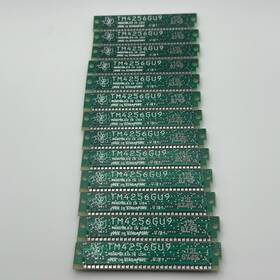
( Brand: Texas Instruments ), ( Manufacturer Part Number: TM4256GU9 ), ( Part Type: Memory Module ), ( Number Of Modules: 12 )
Review TEXAS INSTRUMENTS Memory Ram Modules Lot Of
The **Texas Instruments TM4256GU9** is a high-performance, low-power **12-bit, 16-channel Analog-to-Digital Converter (ADC)** module designed for precision data acquisition, signal processing, and embedded control applications. Engineered with Texas Instruments advanced **Delta-Sigma ( ) architecture**, this module delivers exceptional accuracy, linearity, and noise performance, making it ideal for demanding industrial, automotive, and aerospace environments where reliability and precision are critical. The TM4256GU9 operates at a **sampling rate of up to 100 kSPS (kilo-samples per second)** while maintaining an **integral nonlinearity (INL) of 1 LSB** and a **differential nonlinearity (DNL) of 0.5 LSB**, ensuring consistent and repeatable measurements even under dynamic conditions. Its **12-bit resolution** provides a dynamic range of **70.8 dB**, enabling the capture of subtle signal variations in applications such as sensor interfacing, motor control feedback, and high-precision analog monitoring.
Built with **industrial-grade components**, the TM4256GU9 is housed in a **compact, ruggedized module** featuring a **low-power design** that operates efficiently within a **wide supply voltage range of 2.7V to 5.5V**, making it compatible with a broad spectrum of microcontroller and FPGA platforms. The module incorporates **on-chip sample-and-hold circuitry**, reducing external component requirements and simplifying system integration. Its **differential input capability** minimizes noise susceptibility, while the **programmable gain amplifier (PGA)** allows for flexible signal conditioning, accommodating both low-level sensor outputs and full-scale analog inputs. Additionally, the TM4256GU9 includes **serial peripheral interface (SPI) communication**, enabling seamless data transfer to microprocessors and digital signal processors (DSPs) with minimal latency.
Designed for **high-reliability applications**, the TM4256GU9 incorporates **overvoltage protection**, **electrostatic discharge (ESD) safeguards**, and **temperature compensation** to ensure stable performance across an **operating temperature range of -40 C to 105 C**, making it suitable for both indoor and harsh outdoor environments. Its **low-noise architecture** and **high-impedance inputs** further enhance signal integrity, reducing the need for additional filtering or amplification stages. Whether deployed in **industrial automation, automotive diagnostics, renewable energy monitoring, or medical instrumentation**, the TM4256GU9 delivers a robust, scalable solution for precise analog-to-digital conversion, bridging the gap between real-world analog signals and digital processing with unmatched accuracy and efficiency.
**Pros and Cons of buying a Texas Instruments TM4256GU9 (12GB) Memory Modules**
The **Texas Instruments TM4256GU9** is a high-density, low-power DDR4 memory module designed for embedded systems, industrial applications, and high-reliability environments. Below is a detailed breakdown of its advantages and disadvantages.
---
### **Pros**
1. **High Density and Compact Form Factor**
The TM4256GU9 is a **12GB (16GB when paired with a companion module)** DDR4 memory module in a **TSOP (Thin Small Outline Package)** or **BGA (Ball Grid Array)** form factor, making it ideal for space-constrained embedded systems. This allows designers to integrate significant memory into compact hardware without sacrificing performance.
2. **Low Power Consumption**
DDR4 memory is inherently more power-efficient than older DDR3 standards, and the TM4256GU9 is optimized for **low-power applications**. This is particularly beneficial for battery-powered or thermally sensitive devices, reducing heat generation and extending operational life.
3. **High Reliability and Endurance**
Texas Instruments is known for its **industrial-grade memory solutions**, and the TM4256GU9 is designed for **extended operational lifespans** with robust error correction (ECC) capabilities. It is suitable for **aerospace, automotive, medical, and industrial IoT** applications where reliability is critical.
4. **Wide Temperature Range Support**
The module is designed to operate in **extended temperature ranges**, typically from **-40 C to 105 C**, making it suitable for harsh environments such as automotive under-the-hood applications, outdoor sensors, or aerospace systems.
5. **Compatibility with DDR4 Standards**
As a DDR4 module, it supports **higher data transfer rates (up to 2400 MT/s or higher, depending on configuration)** compared to DDR3, enabling faster processing in embedded systems. It also integrates well with modern microcontrollers and FPGAs that support DDR4 interfaces.
6. **ECC (Error-Correcting Code) Support**
Many variants of the TM4256GU9 include **ECC memory**, which helps detect and correct single-bit errors. This is crucial for **mission-critical applications** where data integrity cannot be compromised.
7. **Long-Term Availability and Support**
Texas Instruments provides **extended product lifecycles** for its industrial memory, reducing the risk of obsolescence. This is particularly valuable for long-term projects where component availability is a concern.
8. **Flexible Configuration Options**
The module can be **stacked or paired with companion chips** to achieve higher memory capacities (e.g., 12GB 12GB 24GB). This modularity allows for scalability in system design.
9. **Reduced System Complexity**
By integrating memory directly into a single module, designers can **simplify PCB layouts** and reduce the number of discrete components, lowering assembly complexity and potential failure points.
10. **Compliance with Industry Standards**
The TM4256GU9 adheres to **JEDEC DDR4 standards**, ensuring compatibility with a wide range of development boards, FPGAs (e.g., Xilinx, Intel/Altera), and microcontrollers (e.g., NXP, TI s own ARM-based MCUs).
---
### **Cons**
1. **Higher Cost Compared to Consumer RAM**
Industrial-grade memory, especially with extended temperature ranges and ECC support, is **more expensive** than standard consumer DDR4 modules. This can be a significant drawback for cost-sensitive applications.
2. **Limited Availability and Lead Times**
While Texas Instruments offers long-term support, **industrial memory modules may have longer lead times** compared to off-the-shelf consumer RAM. Procurement planning must account for potential delays.
3. **Complexity in Integration**
DDR4 memory modules require **precise timing settings** (e.g., tCL, tRCD, tRP) and may need **custom initialization sequences** depending on the host controller. This can complicate firmware development, especially for engineers unfamiliar with DDR4 interfaces.
4. **Power and Thermal Management Requirements**
Although DDR4 is more efficient than DDR3, **high-density modules like the TM4256GU9 can still generate heat**. Adequate thermal management (e.g., heat sinks, thermal vias) may be necessary to prevent performance degradation or failure.
5. **Dependency on Texas Instruments Ecosystem**
While the TM4256GU9 is compatible with many platforms, **optimal performance may require Texas Instruments reference designs or support tools**. Engineers using non-TI controllers might face additional challenges in configuration.
6. **Potential for Obsolescence in Consumer Markets**
While Texas Instruments provides long-term support, **consumer DDR4 memory evolves rapidly**, and newer standards (e.g., DDR5) may eventually render the TM4256GU9 obsolete for non-industrial applications.
7. **Limited Upgrade Path**
Unlike consumer systems where RAM can be easily upgraded, **embedded systems using the TM4256GU9 may require full board redesigns** to increase memory capacity, limiting flexibility.
8. **Supplier Lock-In Risks**
Relying on a single supplier (Texas Instruments) for critical memory components introduces **supply chain risks**. If the company discontinues the product or faces manufacturing issues, alternatives may be limited.
9. **Testing and Validation Overhead**
Integrating industrial memory into a system requires **rigorous testing** to ensure reliability under extreme conditions. This adds time and cost to the development process.
10. **Not Ideal for High-Performance Computing (HPC) or Gaming**
While the TM4256GU9 is excellent for embedded and industrial use, it is **not optimized for high-bandwidth or low-latency applications** (e.g., gaming, high-speed data processing). For such cases, consumer-grade DDR4 or newer DDR5 modules may be more suitable.
---
### **Conclusion**
The **Texas Instruments TM4256GU9 (12GB) memory module** is a **highly specialized, reliable, and low-power solution** tailored for **embedded, industrial, and mission-critical applications**. Its strengths lie in **compact form factor, extended temperature operation, ECC support, and long-term availability**, making it ideal for aerospace, automotive, medical, and IoT devices where reliability and durability are paramount.
However, its **higher cost, complex integration requirements, and limited flexibility** for non-industrial applications may not make it suitable for **consumer electronics, gaming, or general-purpose computing**. Engineers must weigh the **trade-offs between performance, reliability, and cost** when deciding whether to use this module.
---
### **Recommendation**
**Use the TM4256GU9 if:**- You are developing an **embedded system** (e.g., industrial control, aerospace, automotive, or medical device) that requires **high reliability, extended temperature operation, and low power consumption**.
- Your application **cannot tolerate data corruption** (ECC support is critical).
- You need a **compact, high-density memory solution** with long-term availability.
- You are working with **Texas Instruments ecosystem** (e.g., TI microcontrollers, FPGAs, or reference designs).
**Avoid the TM4256GU9 if:**- You are building a **consumer-grade product** (e.g., laptop, gaming PC, or general-purpose computer) where cost and performance can be optimized with standard DDR4/DDR5 modules.
- Your project has **tight budget constraints** and cannot accommodate the higher price of industrial memory.
- You require **easy upgradability** or **high-bandwidth memory** (e.g., for AI inference, high-speed data processing, or gaming).
- You are unsure about **DDR4 initialization and timing settings**, as this module requires careful configuration.
**Alternatives to Consider:**- For **consumer or general-purpose use**, standard **DDR4 SO-DIMM modules** (e.g., from Samsung, Micron, or SK Hynix) may be more cost-effective.
- For **high-performance embedded systems**, consider **LPDDR4 or LPDDR5** (lower power, higher efficiency) if bandwidth requirements are moderate.
- For **aerospace or extreme environments**, evaluate **Military-grade memory** (e.g., from Micron s ASSP or Samsung s K4T series) if higher radiation tolerance is needed.
- For **FPGA-based designs**, check **Xilinx s or Intel s recommended DDR4 memory interfaces** to ensure optimal compatibility.
In summary, the **TM4256GU9 is a premium industrial solution** with clear advantages for specialized applications but may not be the best fit for broader or cost-sensitive markets. Always validate compatibility with your specific hardware and application requirements before procurement.
Details:
Assembled in USA / Singapore. Part #: TM4256GU9-12L. Speed: 120ns. Boards show light yellowing consistent with 1987 era.
part #: tm4256gu9 prices
- $11.99-$74.05
specifications servermemor:
- brand: Texas Instruments
- mpn: Tm4256gu9
- part type: Memory Module
- number of modules: 12
payments servermemor:
- credit card: Diners-club
- other
- wallet: Apple-pay
shipping servermemor:
- cost: $9.14
- transit: 5-12 Days
- type: Calculated
- class: Standard
- service: USPS Ground Advantage
- carrier: USPS
returns servermemor:
- policy: No Returns
offer servermemor:
- sold: 0
- availability: In Stock
- started: April 29, 2026
- best offers: True
- quantity: 1
- options: Ship-to-home
seller servermemor:
- # reviews: 7
- rating: 100.0%
- city: Palmer, Texas
general servermemor:
- Enterprise Networking, Servers > Server Components > Server Memory RAM
- condition: Used
Texas Instruments TM4256GU9 Is Similar To:
- Texas Instruments Tmdsdsk6416-t Starter Kit Digital Signal Processor (40.3% similar) You are buying on one spectrum digital starter kit you...(January 12th, 2026)